

Get Legal Advice
(256) 993-5260
Operating Agreements in Alabama:
Originally published: September 2026 | Reviewed by J. Wesley Atkinson
An LLC operating agreement is the internal document that sets out how an Alabama limited liability company is owned, managed, and run — covering ownership percentages, voting rights, profit distribution, and what happens if a member leaves or the business dissolves.
Alabama law doesn’t require that agreement to be written or filed with the state — under Ala. Code § 10A-5A-1.02(l), it can be written, oral, or even implied — but § 10A-5A-2.01(d) contemplates that some form of it exists for every LLC.
Business owners who form an LLC without a tailored written agreement often learn too late that Alabama’s default rules govern everything they never put in writing.
Key Takeaways
- Alabama doesn’t require an LLC operating agreement to be written or filed with the state, and Ala. Code § 10A-5A-1.02(l) allows one to be oral or implied — but § 10A-5A-2.01(d) contemplates that some agreement exists for every LLC.
- Under Ala. Code § 10A-5A-1.08(a), Alabama’s statutory default rules govern any matter the operating agreement doesn’t address, whether the members intended that outcome or not.
- Single-member and multi-member LLCs both benefit from a written agreement, though the provisions each needs differ.
- Only a written operating agreement can limit or eliminate certain member liabilities under Ala. Code § 10A-5A-1.08(b)(2).
An LLC without a tailored written agreement runs on Alabama’s default rules, not the owners’ actual intent. Atkinson Law, P.C. drafts agreements based on how the business actually operates. Talk to a business formation attorney.
What Is an LLC Operating Agreement in Alabama?
Under Ala. Code § 10A-5A-1.02(l), a “limited liability company agreement” is any agreement — written, oral, or implied — among the members governing the LLC’s activities and affairs, regardless of whether it’s formally called an “operating agreement.”
Ala. Code § 10A-5A-2.01(d) states that this agreement “shall be entered into” either before, after, or at the time the certificate of formation is filed — meaning Alabama law contemplates that every LLC has one, even if the members never wrote anything down and it exists only through their conduct.
Ala. Code § 10A-5A-1.08(a) then makes that agreement the primary source of the rules governing member relations; only where the agreement is silent on a matter does the statute step in to fill the gap.
The operating agreement is a private, internal document — it isn’t filed with the Alabama Secretary of State, unlike the certificate of formation that legally creates the LLC. Members keep it in the company’s own records, and it typically isn’t visible to the public.
If you’re ready to get started, call us now!
What an Alabama Operating Agreement Should Cover
A well-drafted written agreement addresses the decisions Alabama’s default statute would otherwise make for the members.
| Provision | What It Establishes |
| Ownership and capital contributions | Each member’s percentage interest and what they contributed to earn it |
| Management structure | Whether the LLC is member-managed or manager-managed, and who holds authority |
| Voting rights | What decisions require a vote, and what percentage is needed to approve them |
| Profit and loss allocation | How income and losses are divided among members |
| Distributions | When and how members receive payouts from company profits |
| Transfer and buyout terms | What happens if a member wants to sell, leave, become disabled, or dies |
| Dissolution procedures | How the LLC winds down and distributes remaining assets |
A written agreement carries a legal advantage an oral or implied one doesn’t: under Ala. Code § 10A-5A-1.08(b)(2), only a written operating agreement can limit or eliminate certain member liabilities for breach of contract or breach of duty, including fiduciary duties.
Single-Member vs. Multi-Member Operating Agreement Provisions
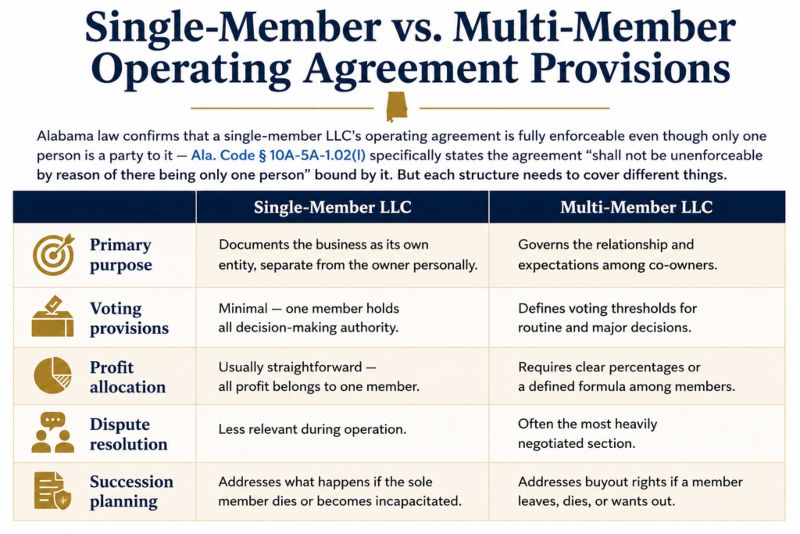
Alabama law confirms that a single-member LLC’s operating agreement is fully enforceable even though only one person is a party to it — Ala. Code § 10A-5A-1.02(l) specifically states the agreement “shall not be unenforceable by reason of there being only one person” bound by it.
But each structure needs to cover different things.
| Single-Member LLC | Multi-Member LLC | |
| Primary purpose | Documents the business as its own entity, separate from the owner personally | Governs the relationship and expectations among co-owners |
| Voting provisions | Minimal — one member holds all decision-making authority | Defines voting thresholds for routine and major decisions |
| Profit allocation | Usually straightforward — all profit belongs to one member | Requires clear percentages or a defined formula among members |
| Dispute resolution | Less relevant during operation | Often the most heavily negotiated section |
| Succession planning | Addresses what happens if the sole member dies or becomes incapacitated | Addresses buyout rights if a member leaves, dies, or wants out |
A single-member LLC without a written agreement has less documentation showing the business operates as its own entity, distinct from its owner—one factor among several a court could consider if the LLC’s separateness is ever challenged, though not the only one.
A multi-member LLC without one leaves every ownership and control question to Alabama’s default statutory rules if the members later disagree.
If you’re ready to get started, call us now!
Does Alabama Law Require an Operating Agreement?
Not a written or filed one. Alabama does not require an LLC operating agreement to be in writing, and it is never submitted to the state — the certificate of formation filed under Ala. Code § 10A-5A-2.01 legally creates the LLC.
But § 10A-5A-2.01(d) does contemplate that a limited liability company agreement exists for every LLC, entered into before, after, or at the time of formation — and under § 10A-5A-1.02(l), that agreement can be written, oral, or simply implied from how the members actually run the business.
In practice, banks, investors, and other outside parties often ask to see a signed operating agreement before opening a business account or extending credit, even when Alabama law doesn’t require a written one.
What Happens Without a Written Operating Agreement in Alabama
An LLC that never adopts a written agreement isn’t ungoverned — it’s governed by whatever the members’ conduct implies, and by Alabama’s default rules under Title 10A wherever that’s unclear.
Under Ala. Code § 10A-5A-1.08(a)(2), the statute controls any matter the members never addressed themselves, whether or not that default outcome reflects what they actually wanted.
One concrete example: under Ala. Code § 10A-5A-4.07(b), if the agreement doesn’t specify who directs and oversees the LLC, the default is member-managed — the LLC’s activities are directed by its members, and ordinary-course matters are decided by a majority vote of members.
That default might work fine for two equal partners. It can create real problems for an LLC with several members holding unequal ownership stakes who never intended every member to get an equal vote.
Members who disagree about a major decision outside the statutory default have no negotiated voting threshold to fall back on. A member who wants to leave has no agreed buyout process, which can turn an exit into a dispute.
And documentation matters generally — a single-member LLC with no written governance record has less to point to if it ever needs to show the business was run as a genuinely separate entity.
Alabama’s default LLC rules rarely match what business partners actually intend. Atkinson Law, P.C. drafts operating agreements around the business, not the statute’s fallback terms. Get your operating agreement drafted.
Bottom Line
- Alabama doesn’t require an LLC operating agreement to be written or filed, and Ala. Code § 10A-5A-1.02(l) allows one to be oral or implied — but § 10A-5A-2.01(d) contemplates that some agreement exists for every LLC, and only a written one can limit certain member liabilities under § 10A-5A-1.08(b)(2).
- Absent a written agreement addressing a matter, Ala. Code § 10A-5A-1.08(a) — and defaults like § 10A-5A-4.07(b)’s member-managed, majority-vote rule — fill the gap.
- Single-member and multi-member LLCs both need one, but the most important provisions differ by structure.
- The certificate of formation creates the LLC legally; the operating agreement governs how it actually runs.
Contact Us Today For An Appointment
Frequently Asked Questions
Does Alabama require an LLC to have a written operating agreement?
No. Alabama doesn’t require the agreement to be written or filed with the state, and Ala. Code § 10A-5A-1.02(l) allows it to be oral or implied. But § 10A-5A-2.01(d) contemplates that every LLC has an agreement, and a written one is far easier to enforce and is required to limit certain member liabilities.
Can a single-member LLC have an operating agreement?
Yes. Ala. Code § 10A-5A-1.02(l) confirms a single-member LLC’s operating agreement is enforceable even though only one person is a party to it. It still serves a real purpose — documenting that the business operates as its own entity, separate from its owner.
What happens if my Alabama LLC never adopts a written operating agreement?
Alabama’s default statutory rules under Title 10A govern any matter the members never addressed, per Ala. Code § 10A-5A-1.08(a). For example, § 10A-5A-4.07(b) defaults an LLC to member-managed governance with majority-vote decisions unless the agreement says otherwise.
Do I need to file my LLC operating agreement with the State of Alabama?
No. The operating agreement is a private internal document kept in the company’s own records. Only the certificate of formation, filed under Ala. Code § 10A-5A-2.01, is submitted to the Alabama Secretary of State to legally create the LLC.
Can an operating agreement override Alabama’s LLC statute?
Partially. Ala. Code § 10A-5A-1.08 lets members customize most internal rules through the agreement, but certain protections — like third-party rights and the LLC’s status as a separate legal entity — can’t be altered no matter what the agreement says.
Every LLC runs on some set of rules — either ones the members chose or Alabama’s statutory default. Atkinson Law, P.C. helps North Alabama business owners put their own terms in writing before a dispute forces the issue. Schedule a consultation.