

Get Legal Advice
(256) 993-5260
Originally published: July 2026 | Reviewed by J. Wesley Atkinson
A business contract is a legally enforceable agreement between two or more parties that spells out obligations, payment, and remedies for a specific Alabama transaction.
Alabama contracts fail when a required element is missing, a clause is unenforceable under state law, or a dispute-resolution provision was never negotiated.
A contract formation attorney drafts and reviews these agreements before a business owner signs.
Key Takeaways
- Alabama business contracts need four elements to be enforceable: offer, acceptance, consideration, and mutually agreed terms.
- Alabama law voids non-compete clauses by default unless the agreement fits one of six statutory exceptions under Ala. Code § 8-1-190.
- Alabama courts can strike an unconscionable clause and enforce the rest of the contract under Ala. Code § 7-2-302.
- Alabama’s Statute of Frauds requires real estate sales, suretyship agreements, and goods sales of $500 or more to be in writing, under Ala. Code §§ 8-9-2 and 7-2-201.
A poorly drafted contract can cost you the deal or the lawsuit. Atkinson Law drafts and reviews contracts built to hold up in court.
What Should Every Alabama Business Contract Include?
An Alabama business contract holds up in court when it identifies the parties, states consideration, defines specific terms, includes signatures, and sets out a dispute-resolution provision.
Atkinson Law, P.C., a Decatur, Alabama, business and contract law firm serving Huntsville, Athens, and Morgan, Lawrence, and Limestone Counties, drafts and reviews these agreements for local business owners. J. Wesley Atkinson, Attorney at Law, reviews each component below before a client signs.
Identifying each party correctly starts with knowing the business’s legal structure, so an owner who hasn’t yet formed an entity should review LLC formation in Alabama before signing contracts personally.
Who Are the Parties to an Alabama Business Contract?
The parties section names every person or entity bound by the agreement, using each party’s full legal name and business structure so a court can identify who owes what to whom.
An LLC, corporation, or sole proprietor signs differently, and the signature block must match the entity’s formation documents exactly, so a mismatch doesn’t give the other side grounds to challenge enforcement later.
If you’re ready to get started, call us now!
What Is Consideration and Why Does an Alabama Contract Need It?
Consideration is the value each party exchanges under an Alabama contract — money, services, goods, or a binding promise — and a contract without it is generally unenforceable.
Alabama courts require each side to give up something of legal value; a one-sided promise with nothing exchanged in return does not create a binding contract.
Nominal or unequal consideration still counts as valid consideration under Alabama law, so a business owner cannot void a bad deal simply by arguing the price was too low.
What Terms Should an Alabama Business Contract Specify?
The terms section spells out each party’s specific obligations — price, deliverables, deadlines, and performance standards — so neither side can later claim the agreement meant something else.
Vague terms often lead to Alabama contract litigation, since a court must interpret undefined language against the party who drafted it.
Businesses restructuring around a new entity should confirm whether existing contract terms need updating — comparing an S-Corp election often changes who signs future agreements, so contract terms and entity paperwork should be updated together.
Vague contract terms turn into expensive disputes down the road. Atkinson Law writes specific, enforceable terms before a disagreement ever reaches court.
How Should a Dispute Resolution Clause Work in an Alabama Contract?
A dispute-resolution clause specifies the forum, procedure, and governing law that apply if the parties disagree, and it determines whether a dispute goes to court, arbitration, or mediation before a dispute arises.
A well-drafted clause also states whether the parties must attempt mediation before filing suit, since mediation resolves Alabama business disputes faster and less expensively than litigation.
Alabama also permits parties to submit a contract dispute to binding arbitration under its statutory arbitration and award provisions, allowing businesses to resolve disputes privately rather than in open court.
Does an Alabama Business Contract Need to Be in Writing?
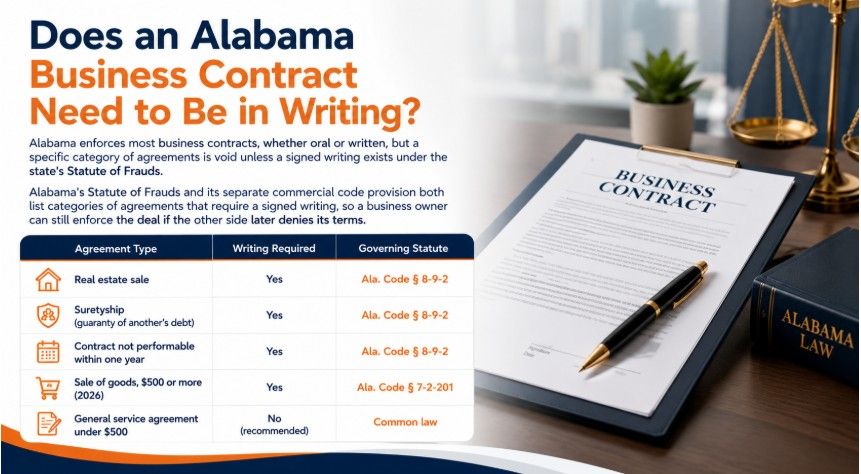
Alabama enforces most business contracts, whether oral or written, but a specific category of agreements is void unless a signed writing exists under the state’s Statute of Frauds.
Alabama’s Statute of Frauds and its separate commercial code provision both list categories of agreements that require a signed writing, so a business owner can still enforce the deal if the other side later denies its terms.
| Agreement Type | Writing Required | Governing Statute |
| Real estate sale | Yes | Ala. Code § 8-9-2 |
| Suretyship (guaranty of another’s debt) | Yes | Ala. Code § 8-9-2 |
| Contract not performable within one year | Yes | Ala. Code § 8-9-2 |
| Sale of goods, $500 or more (2026) | Yes | Ala. Code § 7-2-201 |
| General service agreement under $500 | No (recommended) | Common law |
Owner-financed property deals are a common example — the seller-financing agreement itself must be in writing to be enforceable under Alabama’s Statute of Frauds.
If you’re ready to get started, call us now!
What Makes a Contract Clause Unenforceable in Alabama?
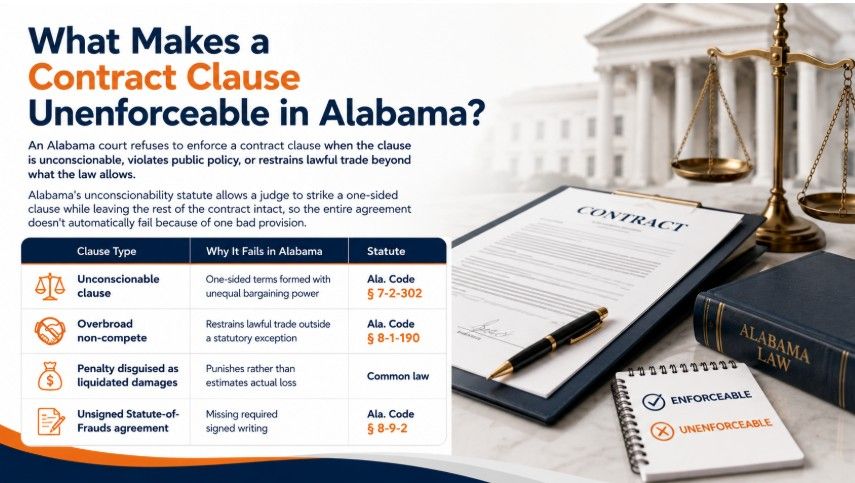
An Alabama court refuses to enforce a contract clause when the clause is unconscionable, violates public policy, or restrains lawful trade beyond what the law allows.
Alabama’s unconscionability statute allows a judge to strike a one-sided clause while leaving the rest of the contract intact, so the entire agreement doesn’t automatically fail because of one bad provision.
| Clause Type | Why It Fails in Alabama | Statute |
| Unconscionable clause | One-sided terms formed with unequal bargaining power | Ala. Code § 7-2-302 |
| Overbroad non-compete | Restrains lawful trade outside a statutory exception | Ala. Code § 8-1-190 |
| Penalty disguised as liquidated damages | Punishes rather than estimates actual loss | Common law |
| Unsigned Statute-of-Frauds agreement | Missing required signed writing | Ala. Code § 8-9-2 |
Are Non-Compete Clauses Enforceable in Alabama Business Contracts?
Alabama voids non-compete clauses by default, and a non-compete only survives if it fits one of six narrow statutory exceptions designed to protect a genuine business interest.
Alabama’s restrictive covenant statute presumes a two-year non-compete reasonable in duration when it falls within an allowed exception, such as the sale of a business’s goodwill or protection of trade secrets.
A non-compete written into an ordinary employment or vendor contract without fitting an exception is void from the start, so the clause cannot later be enforced in court no matter how it is worded.
What Red Flags Should You Look for Before Signing a Business Contract?
The clearest red flags in an Alabama business contract are undefined payment terms, one-sided termination rights, and a missing or vague dispute-resolution clause.
A contract that lets only one party terminate at will, or that buries an automatic renewal clause in dense language, shifts risk onto the party who signs without reading closely.
Contracts tied to a property purchase carry additional risk — a business owner leasing or buying commercial space should have a real estate attorney review the property terms alongside the business terms, so that no conflicting obligations surface after closing.
When Should an Alabama Business Owner Have a Contract Reviewed?
An Alabama business owner should have a contract reviewed before signing any agreement involving a new vendor, a non-compete clause, or a deal larger than a routine purchase.
Reviewing a contract before signature costs far less than litigating an unenforceable or one-sided clause after a dispute begins.
Contract review sits alongside the other services a growing business needs — from entity formation to real estate — keeping every agreement consistent as the business expands.
Contact Us Today For An Appointment
Frequently Asked Questions
What must an Alabama business contract include to be enforceable?
An enforceable Alabama business contract needs four elements: an offer, an acceptance, consideration exchanged between the parties, and mutually agreed terms. Courts also expect identified parties and signatures, though Alabama does not require a contract to use specific words or formal structure.
Who can be a party to a business contract in Alabama?
Any person or business entity — including an LLC, corporation, or sole proprietor — can be a party to an Alabama business contract. The signature block must match the entity’s formation documents exactly, or the other side may have grounds to challenge enforcement.
Does a business contract in Alabama have to be in writing?
Alabama enforces most business contracts, whether oral or written, but the state’s Statute of Frauds voids certain categories unless a signed writing exists. Real estate sales, suretyship agreements, and goods sales of $500 or more all require a signed writing to be enforceable.
What is consideration in an Alabama business contract?
Consideration is the value each party exchanges under a contract — money, services, goods, or a binding promise. Alabama law requires consideration on both sides for a contract to be enforceable, though the value exchanged need not be equal, only given by each party.
What happens if a contract clause is found unconscionable in Alabama?
An Alabama court can refuse to enforce an unconscionable clause while leaving the rest of the contract intact, under Ala. Code § 7-2-302. The clause does not void the entire agreement — the court may instead limit or remove only that provision and enforce what remains.
Are non-compete clauses enforceable in Alabama?
Alabama voids non-compete clauses by default under Ala. Code § 8-1-190, unless the agreement fits one of six statutory exceptions, such as protecting trade secrets or the sale of a business’s goodwill. Courts presume a two-year non-compete is reasonable in duration when an exception applies.
Does an Alabama business contract need a dispute resolution clause?
Alabama law does not require a dispute-resolution clause, but omitting one leaves the parties without an agreed forum, procedure, or governing law if a disagreement arises. A well-drafted clause can require mediation or binding arbitration before either side ever files a lawsuit in circuit court.
What red flags should you look for before signing a business contract in Alabama?
Watch for undefined payment terms, one-sided termination rights, and a missing or vague dispute-resolution clause before signing an Alabama business contract. A clause that lets only one party cancel at will, or an automatic renewal buried in dense language, signals risk for the signer.
When should an Alabama business owner have a contract reviewed?
An Alabama business owner should have a contract reviewed before signing any agreement involving a new vendor, a non-compete clause, or a deal larger than a routine purchase. Reviewing early costs far less than litigating an unenforceable or one-sided clause after a dispute begins.
Every contract you sign becomes a promise the law will hold you to. Call Atkinson Law before you sign, not after something goes wrong.