

Get Legal Advice
(256) 993-5260
Alabama Tax Lien Foreclosure Law:
Originally published: October 2026 | Reviewed by J. Wesley Atkinson
Reviewed by J. Wesley Atkinson, a Decatur real estate and title attorney whose decade-plus tenure as Assistant Counsel at Redstone Title Services centered on title searches and title claim resolution.
Alabama tax lien foreclosure is the circuit court process a tax lien certificate holder uses to convert an unredeemed property tax lien into ownership of the parcel.
Act 2024-261, effective October 1, 2024, rewrote that process by extending the waiting period, requiring detailed pre-suit notice, and giving owners the right to demand a public auction.
Atkinson Law, P.C., a Decatur, Alabama, real estate attorney practice, reviews the title consequences of these liens for owners and investors across Morgan, Limestone, and Lawrence Counties.
Key Takeaways
- Ala. Code § 40-10-197 generally allows a lien holder to file foreclosure no earlier than 4 years and no later than 10 years after the lien auction or sale.
- Pre-suit notice must be mailed at least 30 days and no more than 180 days before the foreclosure complaint is filed.
- Ala. Code § 40-10-184 caps the opening tax lien auction bid at 12% interest, and each subsequent bid must be lower.
- Ala. Code § 40-10-198 bars a certificate holder from entering or possessing the property until a court action produces a clerk’s deed.
An unanswered tax lien can result in lost ownership. Atkinson Law, P.C. offers a tax lien title review that maps the lien’s current status.
How Does an Alabama Tax Lien Sale Differ From a Tax Sale of the Property?
Alabama counties collect delinquent property taxes through one of two systems, and each county’s tax collecting official chooses one under Ala. Code § 40-10-180, publishing that choice by October 1. A tax lien auction sells only the county’s claim for the unpaid taxes, while a traditional tax sale sells the property itself, subject to redemption.
| Feature | Tax Lien Auction | Tax Sale of the Property |
| Governing law | Ala. Code § 40-10-180 and following sections | Ala. Code § 40-10-1 and following sections |
| What the buyer receives | A tax lien certificate | A certificate of purchase |
| How bidding works | Bidders compete down from a 12% interest cap | Bidders compete on price |
| Owner’s redemption rights | Redemption allowed until a foreclosure judgment is entered | 3-year statutory redemption; judicial redemption may remain available in some circumstances, such as continued possession |
| Path to ownership | Foreclosure and quiet title action under § 40-10-197 | Tax deed, followed by title-clearing steps |
The redemption distinction matters most. Statutory redemption under Ala. Code § 40-10-120 runs 3 years from a traditional tax sale. However, an owner who stays in possession may still hold a judicial redemption right afterward, so the 3-year mark does not automatically end every remedy.
Buyers who find a recorded tax certificate before a North Alabama closing should confirm which system produced it before finalizing the title commitment.
What Changed in Alabama Tax Lien Law in 2024?
Two 2024 acts changed how Alabama tax liens are sold, held, and foreclosed. Act 2024-261 rewrote the foreclosure statute and the excess-funds statute, and Act 2024-324 revised the tax lien auction article that begins at § 40-10-180.
Act 2024-261: Foreclosure and Excess Funds
Act 2024-261 took effect October 1, 2024, and governs any tax lien without a final foreclosure judgment as of that date. The act made five main changes:
- Extended the minimum wait before foreclosure from 3 years to 4 years
- Added a mandatory pre-suit notice with required contents
- Required the holder to file an affidavit describing how interested parties were identified
- Gave anyone entitled to redeem the right to demand a public auction
- Let a former owner claim excess traditional tax-sale funds by recording a release and waiver of redemption rights
The excess-funds change sits in Ala. Code § 40-10-28 and applies to surplus bids from traditional tax sales, which the county commission pays on proper proof. Surplus from a lien foreclosure auction follows a separate court-supervised process described below.
Act 2024-324: Auction Procedure and Holder Limits
Act 2024-324 took effect June 1, 2024, and reworked the auction and holding rules. The act lets a holder buy later-year liens on the same parcel before the next auction, allows title report costs in the redemption amount, and confirms the no-possession rule before a clerk’s deed.
Investors who resell after a foreclosure under the new rules should confirm what an owner’s title policy will cover on a tax-derived title before listing.
How Does Tax Lien Foreclosure Work in Alabama?
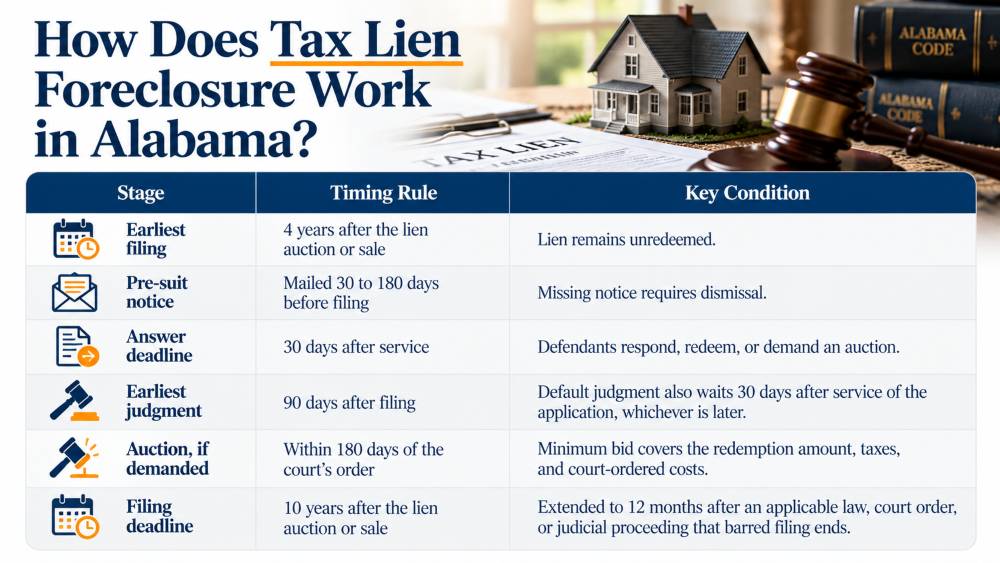
Tax lien foreclosure in Alabama is a single circuit court action that either vests fee simple title (full ownership) in the holder or sends the parcel to auction. Ala. Code § 40-10-197 sets the sequence below.
| Stage | Timing Rule | Key Condition |
| Earliest filing | 4 years after the lien auction or sale | Lien remains unredeemed |
| Pre-suit notice | Mailed 30 to 180 days before filing | Missing notice requires dismissal |
| Answer deadline | 30 days after service | Defendants respond, redeem, or demand an auction |
| Earliest judgment | 90 days after filing | Default judgment also waits 30 days after service of the application, whichever is later |
| Auction, if demanded | Within 180 days of the court’s order | Minimum bid covers the redemption amount, taxes, and court-ordered costs |
| Filing deadline | 10 years after the lien auction or sale | Extended to 12 months after an applicable law, court order, or judicial proceeding that barred filing ends |
The ordinary 10-year limit has exceptions. When an applicable law or court order barred the holder from suing, or a judicial proceeding prevented filing, the deadline extends to 12 months after that bar ends, so neither an investor nor an owner should treat an old lien as expired without checking the procedural history.
A judgment ends in a clerk’s deed, the court-issued deed that transfers title to the holder and gets recorded with the probate judge.
Recorded easements, utility rights, and covenants survive the judgment, consistent with how Alabama easements generally run with the land.
If you’re ready to get started, call us now!
What Notice Must a Tax Lien Holder Give Before and During the Case?
Alabama tax lien foreclosure involves two separate notice stages: a pre-suit mailing and formal litigation service.
The pre-suit notice goes by certified or first-class mail to every owner of record, recorded mortgage and judgment lienholders, the county tax collecting official, and anyone else reasonably believed to hold an interest, including apparent heirs and business entity agents.
Pre-Suit Notice and Affidavit
The pre-suit letter must identify the owner, parcel number, legal description, street address, and holder, and warn recipients about the upcoming lawsuit and their right to redeem.
The holder then files an affidavit with the complaint listing every person notified and the records searched to find them.
Litigation Service
The complaint must name every person entitled to redeem. Service of the complaint follows Ala. Code § 6-6-563; notice is also published under § 6-6-564, and answers are due within 30 days of service under § 6-6-565.
The holder also records notice of the pending action under Ala. Code § 35-4-131, and the court appoints a guardian ad litem for minors, incapacitated persons, or unknown parties.
Families holding heir property should watch for both stages because the court must protect unidentified heirs.
What Should an Owner Do After Receiving a Tax Lien Foreclosure Notice?
An Alabama owner who receives a pre-suit notice should treat the mailing date as the start of a short planning window, since the holder can file suit as soon as 30 days later. Practical first steps include:
- Keeping the notice and envelope, and recording the mailing date
- Checking with the county circuit clerk whether a complaint has been filed
- Requesting the current redemption amount from the tax collecting official or, after filing, the court
- Gathering the deed, tax receipts, and any mortgage statements
- Requesting a title review to identify other recorded liens or co-owners
A prompt response keeps more options open, including redemption before suit, redemption into court, or an auction demand.
Filing deadlines can arrive faster than owners expect. Atkinson Law, P.C. reviews the recorded file so owners can assess their options early.
How Long Do Alabama Owners Have to Redeem a Tax Lien?
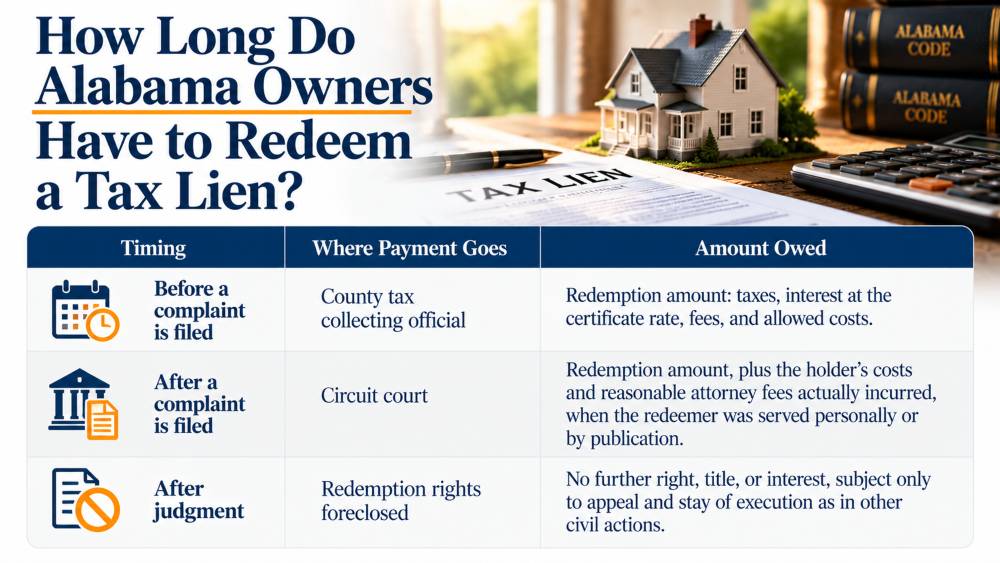
An Alabama owner, heir, mortgagee, or other interested party can redeem a tax lien until the circuit court enters a foreclosure judgment. Redemption costs change once a complaint is filed, as the comparison shows.
| Timing | Where Payment Goes | Amount Owed |
| Before a complaint is filed | County tax collecting official | Redemption amount: taxes, interest at the certificate rate, fees, and allowed costs |
| After a complaint is filed | Circuit court | Redemption amount, plus the holder’s costs and reasonable attorney fees actually incurred, when the redeemer was served personally or by publication |
| After judgment | Redemption rights foreclosed | No further right, title, or interest, subject only to appeal and stay of execution as in other civil actions |
An owner who cannot redeem can demand a public auction before judgment, conceding title to the highest bidder.
The court then pays auction costs, the holder’s redemption amount, taxes, and approved costs, and distributes any surplus to the owners or other proper parties.
Once a redemption certificate is issued, recording it and confirming the release follows the same steps owners use to remove a lien before a sale or refinance.
What Risks Do Investors Face When Buying Alabama Tax Liens?
Alabama tax lien investors face longer holding periods, strict notice and certificate requirements, and the possibility of an auction instead of a deed.
A foreclosure judgment requires the holder to hold every sold, unexpired, outstanding certificate on the parcel, so a missing later-year certificate can stall the case.
Core Holding Risks
- Longer holding period: The 4-year minimum ties up capital a full year longer than the prior rule.
- No early possession: Ala. Code § 40-10-198 blocks entry, repairs, and rent demands until a clerk’s deed issues.
- Other taxes: A holder must pay due taxes and any unsold liens before filing, and must deposit taxes another party paid, plus interest.
- Auction demand: An auction caps the holder’s recovery at the redemption amount, taxes, and court-approved costs.
Pre-Purchase and Pre-Foreclosure Checks
- Confirm every outstanding certificate on the parcel and its holder
- Pull the deed chain to identify owners, heirs, and lienholders who must receive notice
- Search for bankruptcy filings, court orders, or other judicial proceedings that may affect the filing window
- Review recorded easements and covenants that will survive foreclosure
A clerk’s deed transfers title, but a title underwriter must still review the foreclosure file before a resale.
A separate quiet title action, a lawsuit that confirms ownership against competing claims, may be needed when gaps appear outside the foreclosure case.
Contact Us Today For An Appointment
Frequently Asked Questions
How long does an Alabama tax lien holder wait before foreclosing?
An Alabama tax lien holder must wait at least 4 years after the lien auction or sale before filing under Ala. Code § 40-10-197. The ordinary deadline is 10 years, extended to 12 months after any law, court order, or proceeding barring suit ends.
Who can redeem an Alabama tax lien?
Alabama law allows the owner, the owner’s heirs, a mortgagee or purchaser, and anyone else with an interest in the property, including a judgment creditor, to redeem a tax lien. Redemption remains available until the circuit court enters a foreclosure judgment.
Can an Alabama owner keep the property after a tax lien foreclosure is filed?
An Alabama owner can keep the property after a tax lien foreclosure is filed by redeeming before judgment. The owner pays the redemption amount into circuit court, plus the holder’s costs and reasonable attorney fees actually incurred, when served personally or by publication.
Can an Alabama owner demand an auction instead of redeeming?
An Alabama owner or other party entitled to redeem can demand a public auction before judgment instead of paying the lien. The owner gives up title to the highest bidder but becomes eligible for any surplus the court distributes after paying the holder and costs.
What happens to surplus money in an Alabama tax lien foreclosure auction?
Surplus from an Alabama tax lien foreclosure auction goes to the former owners, heirs, successors, or other parties the circuit court identifies. The court first pays auction costs, the holder’s redemption amount, taxes, and approved costs, then distributes the remainder under its order.
Can a former owner claim excess funds from a traditional Alabama tax sale?
A former owner can claim excess funds from a traditional Alabama tax sale under Ala. Code § 40-10-28, which allows a claim without redemption if the owner records a release and waiver of redemption rights. The county commission pays the claim on proper proof.
Can a tax lien holder take possession of Alabama property before foreclosure?
A tax lien holder cannot take possession of Alabama property before foreclosure under Ala. Code § 40-10-198. The holder cannot enter, repair, or demand rent from the property until a court action under the tax lien article produces a clerk’s deed in the holder’s name.
Does a tax lien foreclosure wipe out easements and other recorded interests?
A tax lien foreclosure judgment in Alabama does not remove recorded easements, rights-of-way, utility rights, deed restrictions, or covenants. Other recorded liens can be extinguished based on priority, which is why investors review the full title record before filing.
What interest rate does an Alabama tax lien earn?
An Alabama tax lien earns the interest rate the winning bidder offered at auction, which can start no higher than 12% under Ala. Code § 40-10-184. Each later bid must offer a lower rate than the prior bid, and the certificate carries the winning rate.
Bottom Line
Alabama tax lien foreclosure now follows a minimum 4-year wait, a two-stage notice process, and an ordinary 10-year filing limit that can extend when suit is barred, all under Ala. Code § 40-10-197 as rewritten by Act 2024-261.
Owners who receive a notice should quickly confirm the filing status and redemption amount, while investors should verify every outstanding certificate and the full title record before filing.
A tax lien notice carries firm statutory deadlines. Owners and investors can call Atkinson Law, P.C. at (256) 993-5260 to request a title review of the lien.