

Get Legal Advice
(256) 993-5260
Easements in Alabama:
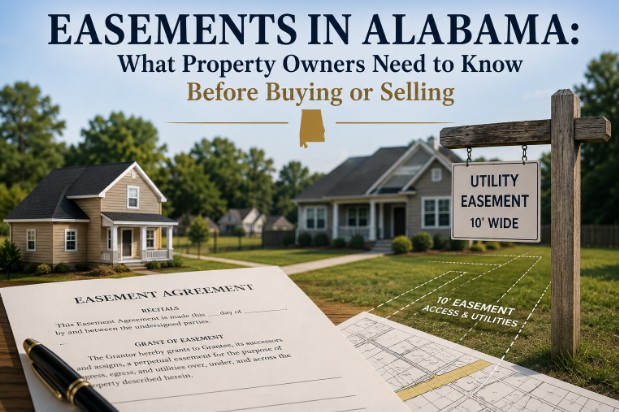
Originally published: September 2026 | Reviewed by J. Wesley Atkinson
An easement is a legal right that allows a specific person, company, or the public to use a defined portion of someone else’s land for a stated purpose, without transferring ownership of that land.
Alabama recognizes utility easements, appurtenant easements, easements in gross, and prescriptive easements, and each type carries different rules for creation, transfer, and termination.
Property owners who skip an easement review before a real estate closing risk inheriting access rights, construction restrictions, or maintenance obligations they never agreed to.
Key Takeaways
- Alabama recognizes four primary easement categories, each created and terminated through different legal mechanisms.
- A prescriptive easement in Alabama requires 20 years of continuous, open, and adverse use under Alabama common law — a separate doctrine from the state’s 10-year statutory adverse possession framework.
- An unrecorded easement can still bind a buyer if the buyer had actual or constructive notice of it before closing.
- A title search and a current survey are the two tools most likely to reveal an undisclosed easement before it becomes a post-closing dispute.
An undisclosed easement can delay your closing or trigger litigation later. Atkinson Law, P.C. reviews recorded easements before you sign. Schedule an easement review.
What Is an Easement Under Alabama Property Law?
An easement is a non-possessory property interest — the easement holder gains a right to use part of the land, while the underlying owner keeps title and every other right of ownership.
Alabama law splits real property interests affecting closings into two broad groups: financial encumbrances (liens, mortgages) and non-financial encumbrances (easements, restrictive covenants), and most easements survive a sale and transfer with the land unless they’ve been properly released or otherwise extinguished.
The property burdened by the easement is the servient estate; a property that benefits from an appurtenant easement is the dominant estate.
A buyer of the servient estate takes the property subject to any valid, existing easement even if the sales contract never mentions it, which is why title review before signing matters more in Alabama than in states with more centralized land registries.
If you’re ready to get started, call us now!
Types of Easements Alabama Property Owners Encounter
Alabama property transactions most commonly involve four easement categories, and each affects a quitclaim or warranty deed transfer differently.
| Easement Type | How It Works | Typical Example |
| Utility Easement | Grants a utility provider access to install and maintain lines or pipes | Power line or water main crossing a rear lot line |
| Appurtenant Easement | Attaches to the land itself and transfers automatically with a sale | Shared driveway benefiting two adjoining parcels |
| Easement in Gross | Benefits a specific person or company, not a neighboring parcel | Billboard lease or a pipeline company’s right-of-way |
| Prescriptive Easement | Arises from 20 years of open, continuous, adverse use under Alabama common law (Bull v. Salsman, 435 So. 2d 27, 29 (Ala. 1983)) | A long-used footpath or driveway crossing a neighbor’s land without a written grant |
Conservation easements are a fifth, less common category recognized under the Alabama Uniform Conservation Easement Act, and they restrict development on the land in exchange for tax or land-use benefits rather than granting physical access.
How Easements Are Created in Alabama
Alabama recognizes three primary paths to a valid easement, and each involves different paperwork and buyer protection.
- Express grant or reservation. A seller conveys an easement in the deed itself, or reserves one when selling the burdened parcel — the most common and most easily verified method.
- Easement by necessity. Arises when a landlocked parcel was once part of a larger tract under common ownership, and Alabama common law recognizes the landlocked owner’s right to reach a public road across the formerly connected land (Hereford v. Gingo-Morgan Park, 551 So. 2d 918 (Ala. 1989)).
- Prescriptive easement. Established through use alone, without any written agreement, once Alabama’s 20-year common-law prescriptive period is met — a use that is open, adverse, exclusive, continuous, and uninterrupted, with the owner’s actual or presumptive knowledge (Bull v. Salsman, 435 So. 2d 27, 29 (Ala. 1983)).
An express easement should be recorded with the county Probate Judge to give future buyers record notice.
Under Ala. Code § 35-4-90, an unrecorded conveyance is void only against a purchaser for value who buys without notice; a buyer who has actual notice of an unrecorded easement, or constructive notice through visible physical evidence or a reference in the chain of title, can still be bound by it even though nothing appears in the county’s recorded index.
How Easements Are Terminated in Alabama
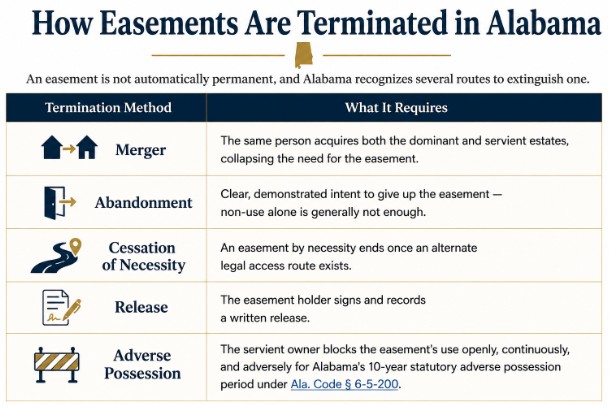
An easement is not automatically permanent, and Alabama recognizes several routes to extinguish one.
| Termination Method | What It Requires |
| Merger | The same person acquires both the dominant and servient estates, collapsing the need for the easement |
| Abandonment | Clear, demonstrated intent to give up the easement — non-use alone is generally not enough |
| Cessation of Necessity | An easement by necessity ends once an alternate legal access route exists |
| Release | The easement holder signs and records a written release |
| Adverse Possession | The servient owner blocks the easement’s use openly, continuously, and adversely for Alabama’s 10-year statutory adverse possession period under Ala. Code § 6-5-200 |
Buyers who assume an old, unused easement has simply expired should confirm termination through a recorded release rather than relying on non-use, since Alabama courts generally require proof of intent to abandon before a court will extinguish an easement.
Property owners already correcting a related title problem — a misspelled name, a wrong legal description, or a boundary conflict — should coordinate that fix through corrective deed procedures rather than trying to resolve an easement dispute through the same instrument, since the two issues require different remedies.
If you’re ready to get started, call us now!
How Easements Affect an Alabama Real Estate Closing
A title commitment issued before closing lists recorded easements as Schedule B exceptions, and whether a buyer’s owner’s title insurance policy covers an unrecorded easement depends on the specific policy form, its stated exceptions, and any survey-related endorsement purchased at closing — coverage is not uniform from policy to policy.
That variability matters: an unrecorded utility line or a decades-old prescriptive footpath can surface after closing with uncertain insurance protection if it wasn’t disclosed, excepted, or discoverable through a reasonable search, which is why reading the actual commitment language matters more than assuming standard coverage.
A survey ordered before closing shows physical evidence of easements — worn paths, utility poles, drainage ditches — that may not appear in the county’s recorded documents.
Buyers closing on Huntsville or Decatur properties should request both a current title commitment and a boundary survey, since either document alone can miss an easement the other would catch.
Sellers financing a sale directly should confirm easement status before drafting seller-financing documents, since an undisclosed easement can affect the collateral value securing the note.
Buyers closing remotely or out of state face the same easement risk as an in-person closing, and should not skip the title review step simply because the closing itself happens by mail.
Buyer Due Diligence Checklist for Easements
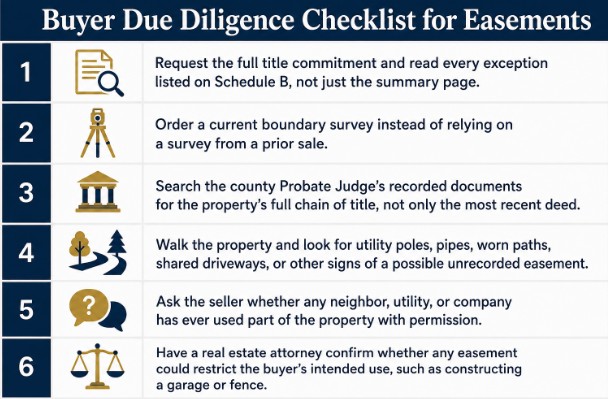
Before signing a purchase agreement, an Alabama buyer should:
- Request the full title commitment and read every exception listed on Schedule B, not just the summary page.
- Order a current boundary survey rather than relying on an old survey from a prior sale.
- Search the county Probate Judge’s recorded documents for the property’s full chain of title, not just the most recent deed.
- Walk the property looking for utility poles, pipes, worn paths, or shared driveways that suggest an unrecorded easement.
- Ask the seller directly whether any neighbor, utility, or company has ever used part of the property with permission.
- Confirm with a real estate attorney whether any listed easement restricts the buyer’s planned use of the land, such as building a garage or fence.
When to Get an Attorney Involved
Some easement situations are worth a legal review before a purchase agreement gets signed, not after:
- The buyer plans construction — a garage, fence, pool, or addition — anywhere near a recorded or suspected easement.
- The property shares a driveway or access road with a neighbor and maintenance responsibilities aren’t clearly documented.
- The parcel is landlocked or partially landlocked and access depends on an easement across another owner’s land.
- An old recorded easement uses vague or conflicting language about its exact location or scope.
- A survey or title search turns up physical evidence of use that doesn’t match anything in the recorded documents.
Skipping a title review is how easements surface after the deed is already recorded. Atkinson Law, P.C. catches them first. Talk to an attorney before closing.
Bottom Line
- Alabama recognizes utility, appurtenant, in-gross, and prescriptive easements, each created and ended differently.
- A prescriptive easement takes 20 years of open, adverse use under Alabama common law—a different doctrine than the state’s 10-year statutory adverse possession rule —and no writing is required for either.
- Ala. Code § 35-4-90 voids an unrecorded easement only against a buyer without notice; a buyer with actual or constructive notice can still be bound by an unrecorded easement.
- A title commitment plus a current survey is the most reliable way to surface an easement issue before it becomes a post-closing dispute, though neither tool guarantees complete disclosure.
Contact Us Today For An Appointment
Frequently Asked Questions
Does an easement transfer automatically when I sell my Alabama property? An appurtenant easement transfers automatically with the land because it’s attached to the property itself, not to a specific owner. An easement in gross generally does not transfer to a new owner and typically requires specific assignability language in the original grant. Confirm the exact grant language with an attorney before assuming transferability.
Can I remove an easement I never use from my Alabama property?
Non-use alone generally does not terminate an easement under Alabama law. A property owner needs a recorded release from the easement holder, proof of merger with the dominant estate, or evidence the holder clearly intended to abandon the right. Consult an attorney before assuming an unused easement has expired.
How do I find out if my Alabama property has an unrecorded easement?
Order a title search through the county Probate Judge’s recorded documents and a current boundary survey before closing. A survey often reveals physical evidence — worn paths, utility lines, shared driveways — that recorded documents alone won’t show. Neither tool alone guarantees complete disclosure.
Does title insurance cover an easement discovered after closing in Alabama? Coverage for an unrecorded easement depends on the specific policy form and its stated exceptions — it is not uniform across every owner’s policy. A recorded easement listed as a Schedule B exception is typically excluded from coverage regardless of when it’s discovered. Review the actual policy and commitment language rather than assuming standard treatment.
What’s the difference between an easement and an encroachment in Alabama? An easement is a legal right to use part of another’s land, created through a grant, necessity, or prescription. An encroachment is an unauthorized physical intrusion, like a fence or shed built over a boundary line, with no legal right. A survey typically identifies both.
A sale deadline is the worst time to discover an unresolved easement. Atkinson Law, P.C. gives you a clear read fast. Get an easement review.