

Get Legal Advice
(256) 993-5260
Heir Property in Alabama:

Originally published: October 2026 | Reviewed by J. Wesley Atkinson
A family may have lived on the same North Alabama land for decades while the deed still names a deceased relative. Before anyone sells, borrows against, or divides that property, the ownership record needs attention.
Heir property in Alabama generally means inherited land shared by relatives, often with an incomplete paper trail. Clearing title starts with identifying every owner and determining which documents or court proceedings are necessary.
Key Takeaways
- Heir property often develops when real estate passes to multiple family members without a completed transfer of clear title.
- Paying taxes, maintaining the property, or living there does not automatically make one heir the sole owner.
- Unclear ownership can make the property difficult to sell, refinance, develop, or transfer with marketable title.
- Clearing heir property title may require estate administration, deeds, a quiet title action, partition, or other legal proceedings, depending on the ownership history.
Before agreeing to a sale, ask Atkinson Law, P.C. about a title review to identify ownership gaps and closing requirements.
What Is Heir Property in Alabama?
Heir property, also called heirs’ property, is family land held by multiple owners after inheritance, commonly without completed estate paperwork. Each owner usually holds an undivided share of the whole property rather than a separately identified parcel.
A one-quarter interest in 40 acres does not automatically give someone ten particular acres. The ownership percentage and the physical boundaries are different questions.
Heirs’ property often has clouded title, meaning the available records leave uncertainty about ownership or competing interests. However, shared inherited ownership does not always mean the title is defective.
Alabama’s partition statute defines heirs’ property specifically. It requires tenancy in common, qualifying family ownership, and no binding written agreement governing partition. A will does not automatically prevent property from qualifying.
How Does Heir Property Develop After Someone Dies?
Heir property commonly develops when an owner dies intestate, meaning without a valid will, and several relatives inherit under Alabama law. Ownership becomes harder to document when later generations also die without resolving their estates.
Consider a hypothetical Morgan County family: three siblings inherit their mother’s land, but nobody updates the ownership records. One sibling later dies, leaving additional successors. A proposed sale now requires tracing both generations, not simply collecting signatures from the surviving siblings.
Who is entitled to inherit depends on the family circumstances, including a surviving spouse and descendants. Being the oldest child, maintaining the house, or handling funeral arrangements does not establish sole ownership.
Proper estate planning can reduce future uncertainty, but an existing family title problem still needs its own review.
If you’re ready to get started, call us now!
Why Can Heir Property Prevent a Sale or Loan?
Unresolved ownership can prevent a seller from delivering acceptable title or a lender from securing its mortgage. The problem is proving who owns the property and who has authority to sign, not an absolute prohibition on selling inherited land.
Common obstacles include missing heirs, deceased co-owners, unpaid liens, inconsistent deeds, and price disagreements. A voluntary sale of the entire property generally requires participation by all owners or someone with valid legal authority to act.
The distinction between title insurance and title correction matters. Buying a policy does not replace the work needed to resolve known ownership defects.
Shared ownership also creates a risk of partition proceedings, while unpaid taxes can threaten the property independently of family disagreements. Keeping taxes current protects the land but does not settle inheritance rights.
How Do You Start Clearing the Title?
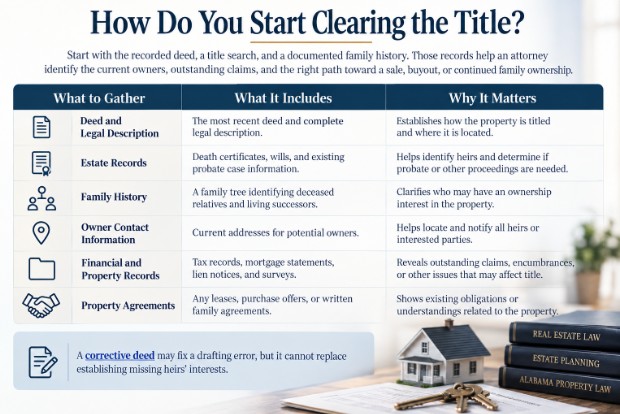
Start with the recorded deed, a title search, and a documented family history. Those records help an attorney identify the current owners, outstanding claims, and the right path toward a sale, buyout, or continued family ownership.
Gather these materials before the first review:
- The most recent deed and complete legal description.
- Death certificates, wills, and existing probate case information.
- A family tree identifying deceased relatives and living successors.
- Current addresses for potential owners.
- Tax records, mortgage statements, lien notices, and surveys.
- Any leases, purchase offers, or written family agreements.
A corrective deed may fix a drafting error, but it cannot replace establishing missing heirs’ interests.
Search land records in the county where the property lies. Tax records are useful leads, but they do not replace deeds and estate records. The Alabama legal toolkit explains why tracing each generation is essential.
If a buyer is already waiting, contact Atkinson Law, P.C. before committing to a closing date. Ask which title documents the transaction requires.
Which Legal Process Can Clear Heir Property Title?
Estate administration, agreed transfers, quiet-title litigation, and partition address different problems. The right choice depends on whether ownership is undocumented, disputed, or established but divided among owners who cannot agree.
Estate administration: Probate proceedings may be needed to establish authority, address estate obligations, and document succession.
Before choosing this route, an attorney should review existing cases, the date of death, and any will. Several generations can involve several estates.
Agreed transfers: When the owners and their shares are established, a negotiated buyout or properly documented conveyance may resolve the problem without contested litigation. A quitclaim deed transfers only the signer’s interest; it cannot convey shares belonging to absent relatives.
Quiet title: A quiet-title action asks a court to determine ownership or resolve competing claims. Alabama Code § 6-6-540 provides one procedure with possession and other requirements. A judgment does not automatically eliminate valid co-owners or consolidate everyone’s shares into one person’s name.
Partition: A partition action addresses ending shared ownership through division or, when legally appropriate, sale. It is different from merely correcting an ownership record.
Atkinson Law, P.C. focuses on transactional real estate work and does not handle litigation. Families needing quiet-title or contested partition proceedings need litigation counsel.
If you’re ready to get started, call us now!
How Does Alabama Protect Heirs Against a Forced Sale?
Alabama’s Uniform Partition of Heirs Property Act provides protections when property meets its statutory definition. These include valuation procedures, opportunities for qualifying co-owners to purchase interests, and a preference for physical division under the statutory standard.
Under § 35-6A-7, a request for partition by sale triggers a structured buyout process. Eligibility, notices, and payment deadlines matter; a relative’s informal offer does not replace a court response.
Under § 35-6A-8, the court prefers physical division unless it would cause great prejudice to the co-owners. The Act does not guarantee the land will remain in the family.
For a rural tract, access and property easements can affect whether separately usable parcels are practical. A house on a small lot presents different division issues from open acreage.
What Should Families Do After Resolving Ownership?
Record the necessary deeds or court orders and confirm that the title requirements for the planned transaction have been met. Then establish how future transfers, expenses, and family succession will be handled.
Keep copies of recorded documents, update relevant tax and insurance records, and confirm any required lien releases. Before a sale, resolve remaining requirements with the closing attorney and title insurer.
Coordinate a will or trust with actual ownership. Planning for a share someone does not legally own cannot repair the title.
Contact Us Today For An Appointment
Frequently Asked Questions
Does Paying Property Taxes Make Me the Owner of Heir Property in Alabama?
No. Paying property taxes does not automatically make one heir the sole owner or eliminate other heirs’ ownership interests. Tax-payment records may matter when determining expenses among co-owners, but a tax bill or receipt in one person’s name is not, by itself, proof of exclusive ownership.
Can One Heir Sell Heir Property Without the Other Heirs in Alabama?
Generally, one heir cannot privately sell the entire property without authority from the other owners or a valid court process. An heir may be able to sell their undivided interest, but that differs from selling the entire property and can affect the rights of the remaining co-owners.
Can Heir Property Be Sold Without Going Through Probate in Alabama?
Sometimes, depending on the title history and how ownership passed after the owner’s death. If a deceased owner remains in the chain of title, probate, estate administration, or another legal proceeding may be necessary before you can establish clear title and sell the entire property.
What Happens If One Heir Refuses to Sell Property in Alabama?
An heir’s refusal may prevent a voluntary sale of the entire property when that owner must participate. Depending on the circumstances, the co-owners may negotiate a buyout, transfer individual interests, or pursue a partition action. The available options depend on the ownership interests and title history.
Can You Sell Heir Property If Not All Heirs Can Be Found?
Potentially, but missing or unlocatable heirs can complicate the process. You must first identify the ownership interests, and additional legal procedures may be required to address heirs you cannot locate. A title review and family-history investigation can help determine what must occur before the property can be transferred.
Is a Family Member Living on Heir Property Considered a Squatter in Alabama?
Not necessarily. A family member who inherited an ownership interest may have possession rights even if other heirs object to the occupancy. Alabama squatter law involves different legal issues. Before assuming eviction, trespass, or adverse-possession rules apply, you must establish the person’s ownership interest.
What Is the Difference Between a Quiet Title Action and a Partition Action in Alabama?
A quiet title action generally resolves uncertainty or competing claims concerning who owns property. A partition action addresses what happens to property that multiple people already own together, including possible division or sale. Families with uncertain ownership may need to establish title first through a quiet title action.
How Long Does It Take and How Much Does It Cost to Clear Heir Property Title in Alabama?
There is no standard timeline or flat cost. Both depend on the title history, number and location of heirs, available estate records, required filings, and whether anyone disputes ownership. A straightforward matter involving cooperative heirs may require fewer steps than one involving deceased, missing, or contesting owners.
For inherited property in Decatur, Huntsville, Athens, or Hartselle, contact Atkinson Law about the title and closing work needed before moving forward.