

Get Legal Advice
(256) 993-5260

Originally published: March 2026 | Reviewed by J. Wesley Atkinson
Under Alabama squatter law, an unauthorized occupant can begin building a legal ownership claim after as little as 10 years of continuous possession on property they did not pay for — and that clock does not reset when the property is sold.
The safest time to catch a squatter problem is before you close, not after. A thorough title review, a physical walk-through, and a conversation with a North Alabama real estate attorney are the three steps that protect you.
What You Don’t Know About Squatter Law in Alabama Could Cost You a Property
Most buyers in North Alabama focus on financing, inspections, and closing costs. Squatters rarely come up — until they do. And when they do, the legal situation is far more complicated than most buyers or sellers expect.
Alabama’s adverse possession laws, codified under Alabama Code § 6-5-200, allow someone who has openly and continuously occupied another person’s property — without permission and without a lease — to eventually claim legal ownership of that land.
That timeline can be as short as ten years if the occupant has what’s called “color of title”: a document that looks like a deed, even if it’s technically invalid.
Here is the detail that most buyers find surprising: squatters’ rights attach to the property, not to you as the owner. A new buyer inherits whatever adverse possession clock was already running when they took title.
If a squatter has been on a vacant lot for eight years before you close, you become the owner of a property with eight years already counted toward a ten-year statutory claim.
The closing table is your last clean opportunity to identify and resolve this risk. Understanding Alabama squatter law — and what to look for before you sign — is not just good practice. For buyers of vacant land, inherited property, foreclosures, and investment properties across Decatur, Huntsville, and North Alabama, it is essential.
Buying vacant or inherited property in North Alabama? Atkinson Law reviews the title and flags squatter risk before you sign anything. Schedule your closing consultation today.
If you’re ready to get started, call us now!
What Is Squatter Law in Alabama? The Basics Every Property Owner Needs to Know
Squatter law in Alabama allows a person who occupies property openly and without permission to claim legal ownership after 10–20 years, depending on whether they have color of title. This is governed by Alabama Code § 6-5-200.
A squatter is someone who occupies a property without a lease, without the owner’s permission, and without any legal right to be there. This is different from a trespasser, who enters briefly, and from a holdover tenant, who had a valid lease that has since expired.
| Occupant Type | Has Lease? | Can Claim Ownership? | How to Remove |
| Trespasser | No | No | Law enforcement |
| Squatter | No | Potentially (adverse possession) | Eviction or HB 182 affidavit |
| Holdover Tenant | Expired | No | Formal eviction (AURLTA) |
For Alabama property buyers, the most critical concept is that holdover tenants are governed by the Alabama Uniform Residential Landlord and Tenant Act (AURLTA), while squatters fall outside that framework entirely.
Neither is easy to remove once established.
Alabama’s 5 Requirements for Adverse Possession — And Why the Clock Doesn’t Stop at Closing
To claim adverse possession in Alabama, a squatter must prove five elements — known as the OCEAN framework — for either 20 years under common law or 10 years under the statutory standard, with color of title and annual tax listings.
Alabama recognizes two pathways to adverse possession. The first is prescriptive adverse possession under common law: 20 continuous years of occupation meeting all five OCEAN requirements.
The second is statutory adverse possession under Alabama Code § 6-5-200: 10 years of occupation with color of title and annual property tax listings.
| Requirement | What It Means | Why It Matters to Buyers |
| Open & Notorious | Occupation is visible and obvious — no hiding | Neighbors and inspectors can spot it |
| Continuous | 20 years uninterrupted (10 with the color of the title) | The clock does not reset when the property is sold |
| Exclusive | Squatter controls the property alone | Shared occupation doesn’t qualify |
| Hostile/Adverse | No permission from the owner | A lease or license stops the clock |
| Actual | Physical use and possession of the land | A mere claim on paper doesn’t count |
One common misconception: paying property taxes is not required for the 20-year prescriptive path. It is only relevant under the statutory 10-year path.
This means a squatter who has been quietly occupying a piece of rural North Alabama land for two decades could have a valid claim without ever paying a dollar in taxes on it.
“Color of title” is worth understanding in plain terms. It does not have to be a legitimate or recorded deed.
It can be an error-filled tax sale document, a contested inheritance document, or even a bogus bill of sale — any paperwork that creates the appearance of ownership.
That document must be recorded in the county’s probate office, which is why a probate records check is part of proper due diligence.
For buyers of inherited or estate-transferred property, the risk is particularly acute. If you are dealing with a corrective deed situation in Alabama, an existing squatter claim on the same property could compound the title problem significantly.
What Alabama’s HB 182 Changed — And What It Doesn’t Fix
House Bill 182, effective June 1, 2024, allows Alabama property owners to file a sworn affidavit with local law enforcement to remove a squatter within 24 hours — without first filing an eviction lawsuit. It also made squatting a Class C felony in certain circumstances.
Before HB 182, removing a squatter in Alabama meant treating them like a tenant: serving notice, filing a court complaint, attending a hearing, and waiting on a Writ of Restitution.
For many property owners, that process took weeks or months, even when the legal outcome was never in doubt.
The new law allows a property owner or authorized agent to submit a sworn affidavit to the law enforcement agency in the county where the property is located.
After 24 hours, law enforcement may remove the squatter and, if appropriate, arrest and charge them for trespass, burglary, or theft.
For the affidavit process to apply, several conditions must be met:
- The person filing is the property owner or an authorized agent
- The occupant entered or remains on the property without permission
- The occupant is not a tenant or holdover tenant
- The occupant is not a family member of the owner
- The owner gave notice to vacate before filing, and the occupant refused
- There is no pending litigation between the owner and the occupant
HB 182 also added criminal teeth. Entering a dwelling with intent to commit a crime, or intentionally causing over $1,000 in damages, is now a Class C felony punishable by one to ten years in prison.
Here is the limitation that matters most for this article: HB 182 helps after you discover squatters. It does nothing to protect a buyer who closes on a property without knowing squatters are there. The time to act is before the deed changes hands.
Atkinson Law helps North Alabama buyers catch squatter problems during due diligence before they become your burden after closing. Contact us to get started.
If you’re ready to get started, call us now!
How to Identify a Squatter Problem Before You Close on Alabama Property
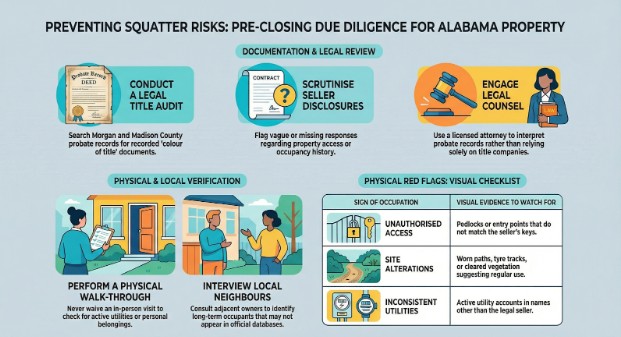
Buyers should conduct a title search, physical walk-through, county probate records check, and neighbor inquiry before closing on any vacant, inherited, or investment property in Alabama.
Each step can surface squatter risk that the seller may not disclose — or may not even know about.
This is the section that no competing resource covers — and it is the most important one for buyers and investors in North Alabama.
1. Conduct a Thorough Title Search
A title search is designed to surface competing claims on a property, including adverse possession attempts.
The probate records in Morgan County and Madison County will reveal whether any color of title documents have been recorded against the property you are buying.
This is one of the primary reasons working with an experienced North Alabama real estate closing attorney matters. A title company can catch most issues, but a licensed attorney reviewing the same records brings legal judgment to what those issues actually mean.
2. Physically Inspect the Property Yourself
Never waive an in-person visit to a property you are buying, especially vacant land, inherited property, or foreclosures.
Signs of squatter occupation are often visible on the ground but invisible in any database. Walk the perimeter. Check all structures. Look for:
- Utilities active in names other than the seller’s
- Mail, personal belongings, or furniture in a vacant structure
- Padlocks or entry points that do not match the seller’s keys
- Worn paths, tire tracks, or cleared vegetation suggesting regular use
- Structures or improvements not shown on the property survey
- Fencing or posted signs placed by someone other than the owner
3. Check County Probate Records for Color of Title Documents
Color of title instruments must be recorded in the county probate office to trigger the 10-year statutory adverse possession clock.
A direct records check in Morgan County or Madison County Probate Court can reveal whether any such documents have been filed against the property.
This is a step your title search may surface automatically, but it is worth confirming explicitly when purchasing any property with a gap in ownership history.
4. Review the Seller’s Disclosure
In Alabama, sellers who have knowledge of squatters or adverse occupants are legally required to disclose that information to potential buyers.
Intentionally concealing a known squatter problem can expose the seller to significant legal liability after closing.
Ask your attorney to review the disclosure documents carefully and flag any vague or missing responses about property access or occupancy.
5. Talk to Neighbors and Adjacent Property Owners
Adverse possession requires occupation that is “open and notorious” — visible to anyone who looks. Neighbors almost always know when someone has been occupying a property for a long time.
A brief conversation during due diligence can reveal years of unauthorized occupation that no database will show.
How to Remove a Squatter in Alabama — Step by Step
Alabama law requires property owners to follow a formal legal process to remove squatters. Under HB 182 (2024), a sworn affidavit with law enforcement can result in 24-hour removal if specific conditions are met. Otherwise, the formal eviction process applies.
If you discover squatters on a property you already own or have just purchased, here is the process under Alabama law:
- Confirm the occupant is a squatter, not a holdover tenant or licensee. This distinction changes your legal options.
- If HB 182 applies: file a sworn affidavit with the county sheriff or relevant law enforcement agency. Law enforcement has the authority to remove the occupant within 24 hours.
- If HB 182 does not apply: serve a written Notice to Vacate. For squatters without any tenancy history, a 10-day Notice to Vacate is standard.
- If the squatter refuses to leave: file an eviction complaint with the Alabama District or Circuit Court in the county where the property is located.
- Attend the court hearing and present documentation of your ownership — deed, title records, tax payments.
- If the judge confirms ownership, a Writ of Restitution will be issued seven days later. The county sheriff executes the removal.
Critical warning: do not attempt self-help eviction. Changing the locks, shutting off utilities, or removing a squatter’s belongings without a court order exposes you to liability under Alabama premises liability law.
Even if the squatter has no legal right to be there, you must follow the legal process.
How to Prevent Squatters on Alabama Property You Already Own
The best protection against adverse possession in Alabama is active ownership: inspect your property regularly, secure all entry points, post no-trespassing signs, pay property taxes on time, and report unauthorized occupants to law enforcement immediately.
Prevention is dramatically easier than removal. Here is a practical checklist for property owners managing vacant land, investment properties, or inherited real estate in North Alabama:
- Inspect vacant property at least once a month — every 90 days at an absolute minimum
- Post “No Trespassing” signs at every access point (Alabama Code § 13A-7-4 supports enforcement when proper signage is in place)
- Install motion-sensor lighting, surveillance cameras, and alarm systems
- Secure all doors, windows, gates, and access points with heavy-duty locks
- Pay property taxes on time and keep payment records as evidence of active ownership
- Fence and clearly demarcate property boundaries to prevent encroachment claims
- Document all maintenance visits with dated photographs
- Report any unauthorized individuals to law enforcement immediately — every day of unreported occupation counts toward the adverse possession clock
- Consider engaging a property management company for long-term vacant investment properties
- If ownership is in dispute, file a quiet title action to establish a clear legal title
Property owners dealing with non-paying tenants — a related but distinct situation — can review our Alabama non-paying tenants timeline and our guide to Alabama’s timeline to legal action for context on how the legal process compares.
Squatter rights transfer with the deed, not the owner. Atkinson Law protects North Alabama buyers before problems follow you home. Schedule your consultation today.
Contact Us Today For An Appointment
Frequently Asked Questions
Can a squatter claim my Alabama property in 10 years?
Yes, under the statutory adverse possession path in Alabama Code § 6-5-200, if a squatter has color of title and has listed the property for taxation annually for 10 years, they may file an adverse possession claim. Without a color of title, the common law standard of 20 continuous years applies.
Does selling a property reset the adverse possession clock?
No. This is one of the most important points in this article. The adverse possession clock attaches to the property, not the owner. If a squatter has been occupying a property for eight years and you buy it without knowing, you inherit that eight-year clock. Proper due diligence before closing is the only protection.
Is squatting a crime in Alabama?
Yes. Under HB 182 (effective June 1, 2024), unauthorized occupation of a dwelling with intent to commit a crime or causing over $1,000 in property damage constitutes burglary in the third degree, a Class C felony punishable by one to ten years in prison.
Can I remove a squatter myself?
No. Self-help eviction — changing locks, shutting off utilities, or removing belongings — is illegal in Alabama and can expose you to civil liability. You must follow either the HB 182 affidavit process (where eligible) or the formal eviction process through the courts.
What if I need to close remotely on Alabama property?
Remote closings are possible in Alabama. Our guide to mail-away and remote closings in Alabama covers what to expect — though we always recommend a physical inspection of the property before any remote closing, particularly for vacant or investment properties where squatter risk is elevated.
What does a real estate attorney do at closing that a title company doesn’t?
A title company processes the transaction. A real estate attorney advises on what the title search actually means, identifies legal risks like squatter claims or color-of-title documents, and can represent you if a dispute arises after closing.
Protect Your Alabama Property — Talk to a Real Estate Attorney Before You Close
The closing table is the best — and often the last — clean opportunity to identify squatter risk before it becomes your legal problem. Once a deed transfers, so does every unresolved adverse possession claim attached to that property.
J. Wesley Atkinson is a North Alabama real estate attorney based in Decatur, serving buyers, sellers, and investors throughout Morgan County, Madison County, and the surrounding region.
His practice covers real estate closings, title review, adverse possession defense, quiet title actions, and ejectment proceedings.
If you are buying, selling, or managing property in North Alabama and want to make sure a squatter problem isn’t waiting for you after closing, reach out before you sign.
Ready to schedule a consultation? Contact Atkinson Law in Decatur, AL, and let’s talk through your situation before you close.
Disclaimer: This article is intended for general informational purposes only and does not constitute legal advice. If you are dealing with a squatter situation or have concerns about a real estate transaction in Alabama, please consult a licensed Alabama attorney.