

Get Legal Advice
(256) 993-5260
Originally published: December 2025 | Reviewed by J. Wesley Atkinson
Alabama real estate doesn’t play by generic, 50-state rules—your choice of deed here truly changes your legal protection.
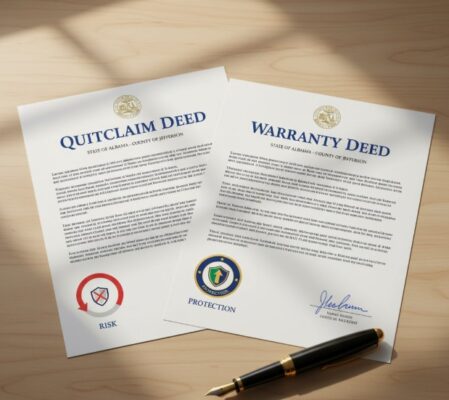
A warranty deed guarantees clear title and provides you with legal recourse if a problem arises. A quitclaim deed simply transfers whatever rights the grantor has at that moment—no promises, no defense, and no safety net.
In Alabama, the right choice depends on who you’re dealing with, your risk tolerance, and the specific wording inside the deed. A single phrase like “grant, bargain, sell” can automatically trigger legal warranties under Alabama law, even if you never meant to create them.
Most buyers use warranty deeds for full protection. Quitclaim deeds appear in family transfers, divorce settlements, LLC transfers, and estate planning—situations where both sides already understand the property’s condition.
Choosing wrong isn’t just inconvenient—it can expose you to liens, title defects, unpaid taxes, and even ownership disputes. That’s why deed selection and wording matter more in Alabama than in many other states.
Key Takeaways
- Warranty deeds give buyers legal protection and title guarantees. Quitclaim deeds don’t offer any assurances.
- Alabama has specific rules for property deed formatting and recording. You need to follow these to make the transfer valid.
- Picking the wrong deed can expose you to significant legal and financial risks. A real estate attorney can help you avoid those.
60-Second Answer (What’s The Difference In Alabama?)
Alabama deeds play by their own rules—specific words can trigger automatic legal protections. The big difference comes down to what warranty language you see in the deed and how Alabama law treats those words.
Why Words Matter On Alabama Deeds (Implied Covenants: “Grant, Bargain, Sell”)
Alabama law steps in when deeds include words such as “grant,” “bargain,” or “sell.” These so-called magic words create implied covenants—basically, built-in promises from the seller.
When you see those words, the seller’s saying, “Yes, I own this property, and nobody else has a claim on it during my time as owner.”
Quitclaim deeds duck those words entirely. Instead, they use phrases like “release” or “quitclaim.” That means the seller isn’t making any promises about ownership or title problems.
Bottom line: If a deed says “John grants to Mary,” it automatically creates warranties. If it says “John quitclaims to Mary,” there are no warranties.
“Statutory Warranty” = Alabama’s Version of Special Warranty
Alabama uses a “statutory warranty deed,” which falls somewhere between a quitclaim and a general warranty deed. This type of deed provides more protection than a quitclaim deed but less than a general warranty deed.
Statutory warranty deeds cover problems that happened while the seller owned the property. If an issue started before they bought it, you’re out of luck.
What statutory warranty covers:
- Title problems the seller caused
- Liens the seller added
- Claims from the seller’s ownership period
What it doesn’t cover:
- Problems from before the seller owned it
- Old boundary fights
- Unpaid taxes from previous owners
Most Alabama deeds use statutory warranty deeds. They strike a balance—enough protection for buyers without imposing too much liability on sellers.
Quitclaim vs. Warranty Deed in Alabama — Quick Comparison Table
| Feature | Quitclaim Deed | Statutory Warranty Deed | General Warranty Deed |
| Title Guarantees | ❌ None | ✅ Limited (grantor’s ownership period only) | ✅ Full (entire chain of title) |
| Who Assumes Most Risk | Buyer | Shared (mostly buyer) | Seller |
| Most Common Use Cases | Family transfers, divorce, LLC/trust | Investor flips, commercial deals | Primary home sales, lender-financed deals |
| Lender Acceptance | ❌ Rare | ✅ Often | ✅ Always |
| Title Insurance Difficulty | High | Moderate | Low |
| Protection Against Past Liens | ❌ None | ❌ Before ownership | ✅ Full protection |
| Protection Against Boundary Issues | ❌ None | ❌ Before ownership | ✅ Full chain |
| Recording Tax Implications | Same as others (unless exempt) | Same | Same |
| Best For | Trusted parties | Investors | Buyers needing full protection |
Alabama’s Deed Laws Are Not “Standard” — Here’s What Makes Them Different
The biggest mistake buyers and sellers make is assuming property deeds work the same in every state. Alabama doesn’t follow the national template. Two things make this state uniquely risky for DIY transfers:
1. Alabama automatically inserts warranties based on specific verbs.
One stray phrase — “grant, bargain, sell” — can legally transform a simple deed into a full-warranty instrument.
2. Alabama’s recording and tax rules create financial consequences if misunderstood.
Privilege taxes, RT-1 forms, legal descriptions, and probate-court workflow all operate differently than in neighboring states.
This is exactly why national “quitclaim vs warranty deed” articles are inadequate for Alabama residents.
The law here contains traps that most people — and even many agents — don’t see coming.
J. Wesley Atkinson, P.C., helps Alabama property owners avoid costly deed mistakes and protect their rights during transfers. Get clarity on your deed options today—contact us.
If you’re ready to get started, call us now!
Types Of Deeds You’ll Actually See In Alabama

Alabama recognizes three main types of deeds for property transfers: general warranty, statutory warranty, and quitclaim.
Each one serves a different purpose depending on how much protection you want and who you’re dealing with.
General Warranty (Broadest Defense—Good For Buyers/Lenders)
A general warranty deed gives Alabama buyers the strongest protection. This deed covers title problems from any point in the property’s history—even before the current owner bought it.
Key protections include:
- Title defects from previous owners
- Unknown liens or encumbrances
- Boundary disputes from any era
- Forgery or fraud in the chain of title
The grantor makes six legal promises called covenants. These covenants kick in if title issues arise later.
Most lenders won’t touch a mortgage without a general warranty deed. Real estate attorneys almost always recommend them for standard home sales between unrelated parties.
The peace of mind is worth the slightly higher cost. Buyers know they can go after the seller if title issues pop up down the road.
Statutory (Special) Warranty (Limited To Grantor’s Ownership Period)
Alabama’s special warranty deed (aka statutory warranty) offers a middle ground. The seller only covers title defects that happened while they owned the place.
Protection covers:
- Liens the current owner created
- Title problems from the grantor’s actions
- Encumbrances during their ownership
Protection excludes:
- Old title defects
- Issues from previous owners
- Ancient boundary disputes
You’ll see these a lot in commercial deals. Businesses want to limit their liability to the period of their ownership.
Developers use them too, especially when selling to investors. It’s a way to offer some protection without taking on the whole history of the property.
Quitclaim (No Covenants; Fastest, Lowest Protection)
A quitclaim deed in Alabama just transfers whatever interest the grantor has—no guarantees, no promises.
Common uses include:
- Family transfers—parents to kids, divorcing spouses
- Estate planning—adding relatives to titles
- Clearing title clouds—removing possible claimants
- Divorce settlements—quick property division
The quitclaim deed is all about speed and simplicity. You can wrap one up in days, and legal fees stay low since nobody’s digging deep into the title.
But let’s be real—buyers get zero protection. If the grantor owns nothing, the buyer gets nothing. Lenders rarely allow quitclaim deeds for mortgages because of the risk.
Which Deed Should You Use in Alabama?
| Situation | Recommended Deed | Why | Risk if You Choose Wrong |
| Buying a primary residence | General Warranty | Full title protection + lender requirement | Buyer inherits old liens or unclear ownership |
| Investor flipping a home | Statutory Warranty | Limits the seller liability to their ownership | Seller becomes liable for old defects |
| Adding/removing spouse | Quitclaim | Fast + no need for warranties | None if both parties trust each other |
| Parent transferring property to child | Quitclaim | Straightforward family transfer | Child assumes all title defects |
| Moving property into an LLC | Quitclaim | The owner is the same party behind the entity | Possible mortgage due-on-sale issues |
| Selling property with known chain gaps | General or Statutory Warranty | Depends on liability acceptance | Lawsuits or title insurance denial |
| Clearing heirship/estate issues | Quitclaim | Removes potential claimants | New owner inherits probate gaps |
When To Use Each Deed In Real Alabama Scenarios

Different situations call for different deeds. Alabama buyers usually want warranty deeds for the best protection, but quitclaim deeds make sense for family or simple transfers.
Primary Residence Sale In Decatur Or Madison County → General Warranty (Buyer & Lender Protection)
If you’re buying a primary home in Decatur or Madison County, you need a general warranty deed for full protection. These transactions involve big money, and you want every legal safeguard you can get.
General warranty deeds require the seller to guarantee a clear title back to the beginning. That covers unknown liens, unpaid taxes, and old disputes.
Mortgage lenders require warranty deeds for most home loans. Banks won’t risk it otherwise, and title insurance companies prefer them too.
Say a Madison County family buys a $350,000 home. At closing, they get a general warranty deed. The sellers guarantee there are no title issues—if something like an old mechanic’s lien pops up, the sellers have to fix it.
Key benefits include:
- Full title protection
- Lender approval
- Easy title insurance
- Legal recourse if things go sideways
Investor Reselling After A Quick Rehab → Statutory/Special Warranty (Limited Lookback)
Real estate investors who flip houses usually use statutory warranty deeds when they sell. They’ve only owned the property for a short time and can’t vouch for the distant past.
Statutory warranty deeds cover the seller’s ownership period only. The investor guarantees no title problems while they had it, but anything before that isn’t their problem.
This setup provides buyers with some protection and prevents investors from getting stuck with old issues. Title insurance can still cover anything outside the seller’s warranty.
For example, an investor in Birmingham buys a foreclosed home, fixes it up, and sells it six months later. The ownership transfer is made through a statutory warranty deed. The investor stands behind their period of ownership, but not before.
Most buyers are fine with this for flips. They know what they’re getting—and what they’re not.
Adding/Removing A Spouse Post-Marriage/Divorce → Quitclaim
Quitclaim deeds work well for spousal property transfers during changes in marriage. These situations involve people who already know each other and understand the property’s title.
When you want to add a spouse to property ownership after marriage, it’s usually a straightforward title transfer. The original owner already knows the property’s history.
There’s no need for warranty protection here, since both parties understand the property’s current condition.
Divorce often means removing an ex-spouse from a property title, and quitclaim deeds make that process easier.
Property transfers between divorcing spouses are usually handled through a quitclaim deed for speed and simplicity. For example, let’s say a couple in Mobile gets married two years after the husband bought their home.
To add the wife to the title, they use a quitclaim deed. The husband transfers half the ownership with no warranties, since they both know the property’s condition inside and out.
Common spousal transfer scenarios:
- Post-marriage additions
- Divorce removals
- Estate planning adjustments
- Prenuptial arrangements
Moving Property Into Your LLC Or Family Trust → Often Quitclaim, But Confirm Lender/Insurer Stance.
People often move real estate into LLCs or family trusts using quitclaim deeds. The ownership benefits don’t really change, even if the legal entity does.
LLC transfers give you liability protection while you keep actual control. You transfer the title to your own company, and since you’re on both sides of the deal, warranty protection isn’t really needed.
Parents often use quitclaim deeds to move homes into family trusts for estate planning. The family keeps control and gets some legal perks, too.
Important considerations include:
- Mortgage due-on-sale clauses
- Title insurance policy impacts
- Tax implications
- Lender notification requirements
Picture a business owner in Huntsville who is moving rental properties into his LLC using quitclaim deeds.
He keeps full control and receives liability protection, and his attorney checked to ensure the transfers wouldn’t trigger mortgage acceleration.
Some lenders or insurers might push back on these transfers. It’s smart to double-check your policies before you make the move.
Choosing between a quitclaim and a warranty deed shapes your financial protection. Work with the team at J. Wesley Atkinson, P.C. for a smooth, legally sound transfer—schedule an appointment.
If you’re ready to get started, call us now!
Alabama-Specific Legal Hooks Most Guides Miss
Alabama law has some unique twists that can affect deed transfers in ways you might not expect.
Statutory requirements and implied warranties sometimes create obligations you didn’t see coming, especially if you’re not familiar with the exact language needed.
Implied Covenants From “Grant, Bargain, Sell” (AL Code § 35-4-271)
Alabama Code § 35-4-271 automatically creates warranties if a deed uses certain words. Using phrases like “grant, bargain, sell” triggers implied covenants—even if the deed isn’t labeled as a warranty deed.
These words automatically create four implied warranties:
- The grantor has a good title to convey
- The property is free from encumbrances
- The grantee will have quiet enjoyment
- The grantor will defend the title
People often toss these phrases into deeds without realizing they’re creating warranties. If a deed says “John Smith grants, bargains, and sells to Mary Jones,” Alabama law treats it as a warranty deed.
This applies even if everyone just wanted a simple transfer. The statutory language actually overrides the parties’ intentions if they use those words.
Attorneys really need to review deed wording closely to avoid accidental warranties. Alabama deed forms demand careful attention to these details.
Recording/Privilege Tax Basics For Deeds (AL Code § 40-22-1)
Before recording any deed in Alabama, you’ve got to pay a privilege tax under AL Code § 40-22-1. The tax is $0.50 per $500 of value, or any part thereof.
Tax calculation examples:
- $100,000 property = $100 tax
- $150,000 property = $150 tax
- $99,500 property = $100 tax
Family transfers—like between spouses, parents and kids, or grandparents and grandkids—can often skip the tax. You have to pay the tax when you record the deed, and the county probate judge collects it and stamps your deed.
County-specific requirements can include extra paperwork. Some counties require affidavits to prove family relationships for tax exemptions.
If you don’t pay the privilege tax, the deed won’t get recorded. That can hold up the transfer and cause title headaches down the road.
“Special” Vs. “Statutory” Warranty Wording On Alabama Forms—Don’t Mix Them
Alabama recognizes both special warranty deeds and statutory warranty deeds, and each comes with different protections. The exact wording you use decides which type applies and what warranties you’re giving.
Special warranty deeds cover only problems that occurred while the grantor owned the property. Anything from before that? Not covered.
Statutory warranty deeds provide complete protection against all title defects, including those arising from prior owners. If you mix language from both forms, you just invite legal confusion.
Courts often try to resolve conflicting warranties, which can expose the grantor to additional liability. Alabama property deed attorneys usually advise sticking to standard forms and avoiding creative language.
Choosing the right form really matters. If you use statutory warranty language, you’re taking on responsibility for every title problem in the property’s history. Special warranty language limits your risk to only the time you own the property.
How Attorneys Actually Analyze Deeds in Alabama
When attorneys review deeds, we look for:
1. The verb structure.
The presence of a grant, bargain, or sale automatically creates legal warranties.
2. The chain-of-title vulnerability.
If any owner in the last 30 years had unclear records, only a general warranty deed protects the buyer.
3. Potential probate entanglements.
Alabama is notorious for heirship disputes. Quitclaim deeds are extremely risky when multiple generations or siblings have had interests.
4. Lender expectations.
Banks expect general warranty deeds for 95% of financed transactions.
5. Insurance underwriter tolerances.
Title insurers may completely decline coverage if the deed history is unstable.
Risks & Red Flags (How People Get Burned)
Property buyers can run into big financial trouble if they don’t understand deed protections.
Dangers of quitclaim deeds include hidden liens and ownership disputes, while buyers with warranty deeds sometimes think they have more title insurance than they actually do.
Why Quitclaim + Purchase Price = Buyer Hazard
Paying market value for a property transferred by a quitclaim deed is risky. The seller gives zero ownership guarantees and still collects full price.
Quitclaim deeds don’t guarantee the grantor owns anything at all. The buyer gets whatever rights the seller actually has, which could be nothing.
Common scenarios where buyers get burned:
- The previous owner never properly recorded their deed
- Seller inherited property through disputed probate court proceedings
- Outstanding mortgages or property taxes create automatic liens
- Co-owners exist, but didn’t sign the transfer documents
In Alabama, buyers have almost no legal recourse against quitclaim grantors. The deed language specifically states that the seller isn’t guaranteeing ownership or the absence of title defects.
Smart buyers pay way less than market value for quitclaim transfers—or they insist on a warranty deed if they’re paying full price.
Undisclosed Encumbrances & Prior Owners (How Warranties Shift Risk)
Warranty deeds move responsibility for title problems from buyers to sellers. This kind of protection is a lifesaver if prior owners left behind liens or legal issues.
General warranty deed coverage includes:
- All liens from any previous owner’s period
- Unpaid property taxes from prior ownership
- Mortgage defaults by earlier owners
- Probate court disputes over inheritance rights
If you sell with a warranty deed in Alabama, you’re personally on the hook for title defects. Buyers can sue you if problems show up after closing.
Special warranty deeds limit your liability to just your ownership period. Anything that happened before you bought? That’s on the buyer.
Quitclaim recipients assume all title risks, regardless of when the issue began. If a previous owner defaulted on a mortgage or left unpaid taxes, those headaches transfer straight to the new buyer—with no recourse.
Title Insurance Expectations By Deed Type (What’s Realistically Insurable)
Title insurance companies base coverage and pricing on the type of deed. Warranty deed transfers usually qualify for standard owner’s policies with broad coverage.
Standard title insurance covers:
- Undisclosed liens and mortgages
- Forged signatures on prior deeds
- Probate court errors in inheritance transfers
- Survey boundary disputes
With quitclaim transfers, title insurance is often limited or more expensive. Insurers know sellers aren’t promising anything about ownership.
Title insurers commonly exclude:
- The rights of parties in possession are not shown in public records
- Unrecorded liens for services or materials
- Property taxes that become liens after the policy date
If you’re buying in Alabama, check your title insurance commitment carefully. Policies for quitclaim deeds may have more exclusions than those for warranty deeds.
Some title companies won’t even offer coverage for certain quitclaim situations, leaving buyers completely exposed to title defects.
Never Use a Quitclaim Deed in Alabama If…
A quitclaim deed becomes dangerous when:
- You’re paying full market value.
- You do not fully trust the seller.
- Title insurance is required.
- A lender is involved in the transaction.
- You’re not 100% sure that no other heirs or owners exist.
- The property came from probate, tax sale, or foreclosure.
- The seller inherited the property without a clean chain of title.
- The seller cannot produce prior deeds, probate orders, or tax clearances.
If even one of these applies, a quitclaim deed can cost you tens of thousands of dollars — and you will have no recourse.
Paperwork, Signatures, And Recording In Alabama
Alabama has specific rules for executing quitclaim and warranty deeds—think signatures, witness or notary requirements, and county recording steps.
Getting the legal description right and understanding the limits of the power of attorney can help you avoid headaches.
Minimum Execution Rules
Every deed in Alabama must be in writing and signed by the person transferring the property. The grantor’s signature needs either a notary or one witness to make it legally valid.
Alabama quit claim deeds need notarized signatures when filing with the probate judge’s office. If you skip the notary, you’ll need a witness signature instead.
The deed should include:
- Full names and addresses of both grantor and grantee
- Legal description of the property being transferred
- Date of transfer
- Signatures of all parties involved
Alabama quitclaim deeds must include these elements to comply with state rules. Miss something, and you might face recording delays or outright rejection.
Where To Record And Typical Turnaround; Why Legal Description Accuracy Matters
Deeds are filed with the Probate Court in the county where the property is located. That’s what gives public notice and updates the official records.
Alabama requires a Real Estate Sales Validation Form (Form RT-1) with every deed. Recording fees depend on the county but usually run $20 to $50.
Most counties complete deed recordings in 1 to 3 business days. But if there’s a mistake in the legal description, you could be in for a long wait.
Legal description accuracy matters because:
- Wrong descriptions can invalidate the transfer
- Survey errors might need a pro to fix
- Property records have to match county records exactly
Each county’s deeds office records these documents in its system. Don’t assume it’s all automatic—details matter.
Power Of Attorney Angle: What A Real-Property POA Can Authorize In Alabama
A power of attorney for real property lets an agent handle property transactions for the grantor. Alabama law says POAs can authorize deed signings, as long as you execute them properly.
The POA document needs to grant authority to specifically:
- Sign deeds on the grantor’s behalf
- Transfer real estate interests
- Execute property documents
General POAs usually don’t cover real estate powers unless you spell it out. The agent signs their own name and makes it clear they’re acting as the grantor’s attorney-in-fact.
Recording requirements include:
- Original POA document or a certified copy
- Deed signed by the authorized agent
- Clear notation of POA authority
The grantee should verify that the POA is still valid and hasn’t been revoked before accepting the deed. If you file POA documents with a deed, expect higher recording fees.
Ensure your Alabama deed is drafted correctly the first time. Protect your property, reduce risk, and keep future disputes off your shoulders with J. Wesley Atkinson, P.C.—contact us.
Contact Us Today For An Appointment
Frequently Asked Questions
What is the difference between a quitclaim deed and a warranty deed in Alabama?
A quitclaim deed transfers whatever interest the grantor has with no title guarantees, while a warranty deed provides legal promises that the title is clear. Buyers in Alabama almost always prefer warranty deeds because they offer legal protection against past claims.
When should I use a quitclaim deed in Alabama?
Use a quitclaim deed when transferring property between trusted parties—such as spouses, family members, or when transferring property into a trust or LLC. It’s not recommended for property sales because there is no title protection for the recipient.
Is a quitclaim deed valid for real estate sales in Alabama?
Yes, but it’s rarely advisable. A quitclaim deed is legally valid for a sale, but buyers receive no protection against liens, boundary disputes, or prior ownership claims. Most Alabama lenders will not accept quitclaim deeds for financed transactions.
What type of warranty deed is used in Alabama?
Alabama commonly uses General Warranty Deeds and Statutory (Special) Warranty Deeds.
- A General Warranty Deed protects against all title defects.
- A Statutory Warranty Deed protects only against issues that arose during the grantor’s ownership.
Do I need a lawyer to prepare a deed in Alabama?
Legally, you are not required to hire a lawyer, but deed wording in Alabama can create implied covenants and unexpected liabilities. Having an attorney draft or review the deed prevents costly recording errors and title defects.
How much does it cost to record a deed in Alabama?
Alabama charges a recording/privilege tax based on the property’s value, usually calculated per $500 of consideration. Additional county recording fees may apply. Exact amounts vary by county, so buyers and sellers should confirm early in the process.
Can a quitclaim deed remove someone from the title in Alabama?
Yes. A quitclaim deed is commonly used to remove a spouse after divorce, clean up heirship issues, or correct ownership interests. However, it only affects the title, not the underlying mortgage, so the removed person may still be financially liable.
Does a quitclaim deed remove someone from the mortgage in Alabama?
No. A quitclaim deed changes ownership but does not remove financial responsibility. Only the lender can release someone from the loan.
Can a deed transfer trigger a property tax reassessment in Alabama?
Yes. Most transfers trigger reassessment unless they qualify for certain exemptions (parent-child, spouse-to-spouse, trust transfers).
Is a quitclaim deed reversible in Alabama?
No. You must record a new deed transferring ownership back, or obtain a court order.