

Get Legal Advice
(256) 993-5260

Originally published: July 2026 | Reviewed by J. Wesley Atkinson
A power of attorney in Alabama is a written legal document that authorizes a trusted agent to make financial, legal, or healthcare decisions on a principal’s behalf.
The Alabama Uniform Power of Attorney Act, codified in Title 26, Chapter 1A of the Code of Alabama 1975, governs all financial POAs executed on or after January 1, 2012.
Healthcare directives fall under a separate statute — Alabama Code § 22-8A-4. J. Wesley Atkinson, Attorney at Law, founder of Atkinson Law, P.C., a Decatur, Alabama, estate planning and transactional law firm, personally drafts every power of attorney for families across North Alabama.
Key Takeaways
- Alabama Code § 26-1A-104 makes every financial power of attorney durable by default unless the document expressly states otherwise.
- Financial POAs require notarized execution under § 26-1A-105; healthcare Advance Directives require two witnesses at least 19 years of age under § 22-8A-4.
- Alabama recognizes four POA types: durable, general (financial), limited (special), and healthcare (Advance Directive for Health Care).
- A properly executed POA eliminates the need for probate court conservatorship proceedings when a principal becomes incapacitated.
Families without a valid power of attorney risk court-appointed conservatorship and months of delay. Schedule an estate planning consultation with Atkinson Law, P.C. at (256) 993-5260.
What Is a Power of Attorney Under Alabama Law?
A power of attorney is a legal instrument in which a principal grants an agent authority to act on the principal’s behalf in financial, legal, or healthcare matters under Alabama’s statutory framework. The Alabama Uniform Power of Attorney Act defines the scope, duties, and limitations of the agent for financial POAs executed on or after January 1, 2012.
Healthcare decision-making authority operates under a separate statute. Alabama Code § 22-8A-4 establishes the Advance Directive for Health Care, which combines a living will with a health care proxy designation.
The two documents carry different execution requirements and serve different legal functions, which is why the Alabama State Bar’s advance directive planning guide recommends drafting both as a coordinated set.
Alabama residents who execute a financial POA without a corresponding healthcare directive leave medical decision-making authority unassigned — forcing family members to seek emergency guardianship through the probate court if the principal becomes unable to communicate treatment preferences to attending physicians.
If you’re ready to get started, call us now!
What Are the Four Types of Power of Attorney in Alabama?
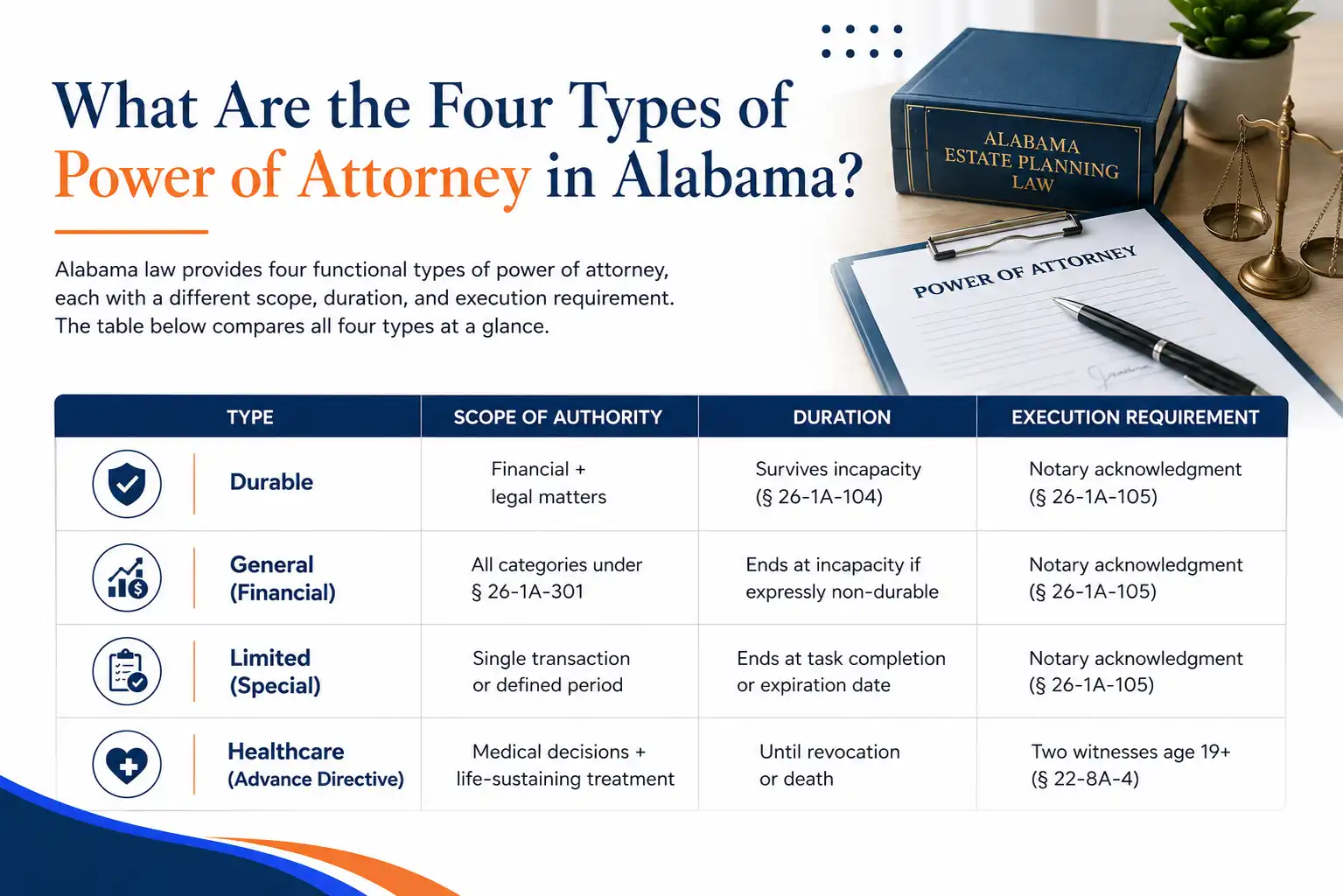
Alabama law provides four functional types of power of attorney, each with a different scope, duration, and execution requirement. The table below compares all four types at a glance.
| Type | Scope of Authority | Duration | Execution Requirement |
| Durable | Financial + legal matters | Survives incapacity (§ 26-1A-104) | Notary acknowledgment (§ 26-1A-105) |
| General (Financial) | All categories under § 26-1A-301 | Ends at incapacity if expressly non-durable | Notary acknowledgment (§ 26-1A-105) |
| Limited (Special) | Single transaction or defined period | Ends at task completion or expiration date | Notary acknowledgment (§ 26-1A-105) |
| Healthcare (Advance Directive) | Medical decisions + life-sustaining treatment | Until revocation or death | Two witnesses age 19+ (§ 22-8A-4) |
Durable Power of Attorney
A durable power of attorney remains effective after the principal becomes incapacitated. Under § 26-1A-104, every POA executed under the Alabama Uniform Power of Attorney Act is presumed durable unless the document expressly states that incapacity terminates the agent’s authority.
Alabama’s default durability provision reversed the state’s prior rule, which required specific durability language for the POA to survive incapacity.
General (Financial) Power of Attorney
A general financial power of attorney grants the agent broad authority over the principal’s financial affairs.
The statutory form under § 26-1A-301 published by the Alabama Cooperative Extension System allows principals to authorize actions across categories including real property, tangible personal property, banking, business operations, insurance, taxes, and government benefits.
Limited (Special) Power of Attorney
A limited power of attorney restricts the agent’s authority to a specific transaction or defined time period. North Alabama homeowners who cannot attend a real estate closing in person frequently use limited POAs to authorize an agent to sign closing documents for one property on one date.
The agent’s authority ends automatically when the transaction closes or the specified period expires.
Healthcare Power of Attorney (Advance Directive)
Alabama does not use the term “healthcare power of attorney” in its statutes. Alabama Code § 22-8A-4 establishes the Advance Directive for Health Care, which appoints a health care proxy authorized to make medical decisions — including decisions about life-sustaining treatment — when the principal’s attending physician determines that the principal can no longer make decisions independently.
The execution requirements differ from those for financial POAs: an advance directive requires two witnesses at least 19 years of age, rather than notarization.
Principals who need both financial and medical coverage should execute a durable financial POA under § 26-1A-301 alongside a separate Advance Directive under § 22-8A-4 — not a single combined document — because Alabama’s statutory forms, signing requirements, and agent authority rules differ between the two instruments.
How Do You Create a Power of Attorney in Alabama?
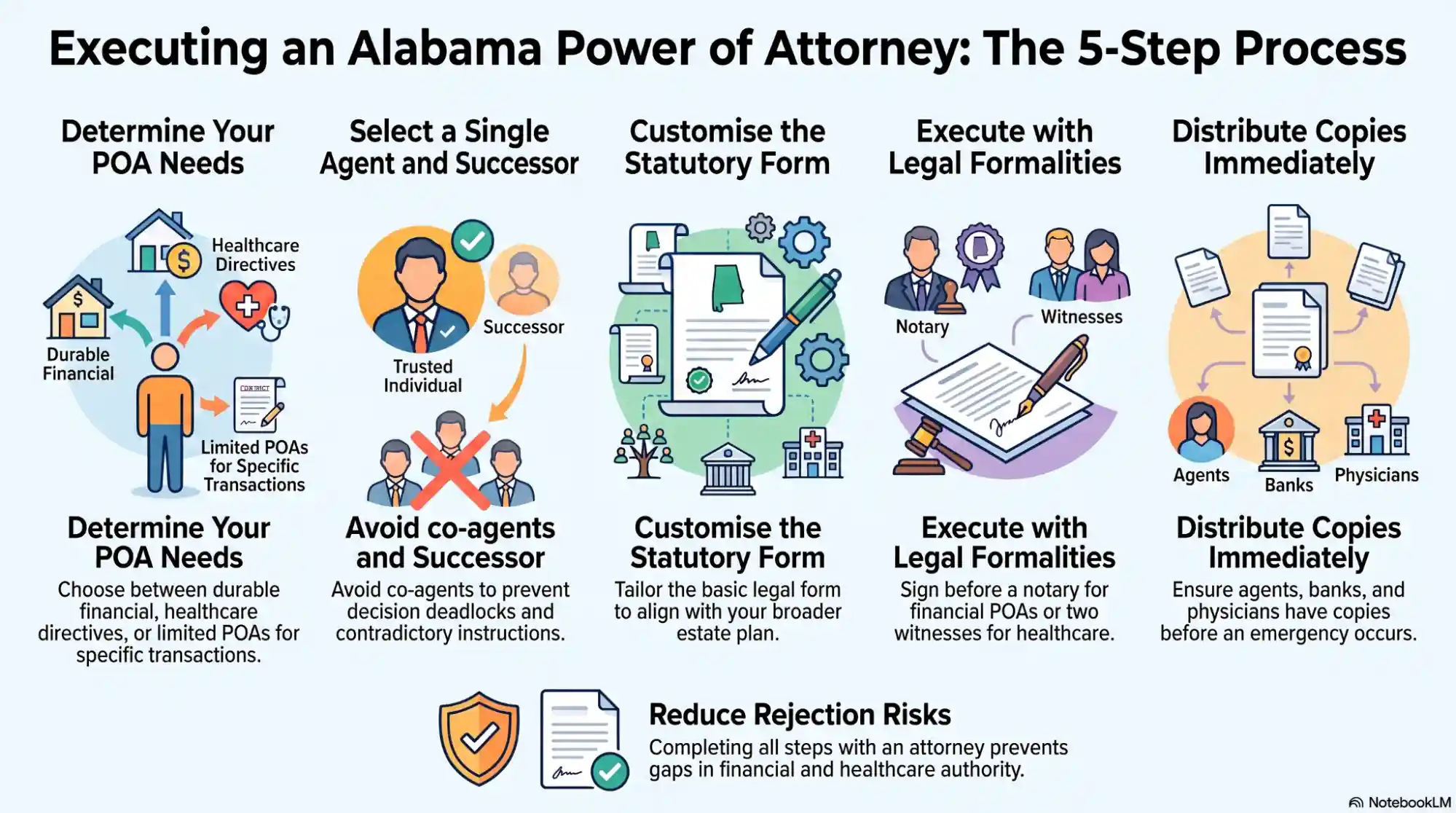
Creating a valid Alabama power of attorney requires five sequential steps, from agent selection through document distribution. Skipping any step can produce a document that banks, title companies, or healthcare providers refuse to honor.
Step 1 — Determine Which Type of POA You Need
Most estate plans include a durable financial POA and a separate Advance Directive for Health Care. A principal who needs authority limited to a single transaction — such as a property closing or vehicle title transfer — may need only a limited POA.
Step 2 — Select an Agent and Successor
Alabama law allows any competent adult to serve as an agent. Most principals choose a spouse, adult child, or trusted family member. Name at least one successor agent in case the primary agent is unable or unwilling to serve.
Avoid co-agents: co-agents acting independently may contradict each other, and co-agents required to act jointly may deadlock on time-sensitive decisions.
Step 3 — Draft the Document
Alabama provides a statutory form under § 26-1A-301, but it is a starting point — not a finished estate planning document.
An attorney customizes the special instructions section to address gift-making authority, real estate transactions, business operations, and trust management in language that aligns with the principal’s broader estate plan.
Step 4 — Execute the Document
For a financial POA, the principal signs the document and acknowledges the signature before a notary public under § 26-1A-105. For a healthcare directive, the declarant signs before two witnesses at least 19 years of age who meet the eligibility requirements under § 22-8A-4(c).
Alabama permits remote notarization under § 36-20-73.1, though in-person execution is more widely accepted by financial institutions.
Step 5 — Distribute Copies
Provide copies of the executed POA to the agent, successor agent, banks, financial advisors, and — for healthcare directives — the attending physician. An undistributed POA sitting in a safe that no one can access provides zero protection during a crisis.
A principal who completes all five steps with an Alabama-licensed attorney reduces the risk of third-party rejection, conflicting document language, and gaps between financial and healthcare authorities that generic online templates routinely produce.
Protect your family’s financial access before a medical emergency forces a conservatorship petition. Contact Atkinson Law, P.C. at (256) 993-5260 today.
If you’re ready to get started, call us now!
What Are the Signing and Notarization Requirements for an Alabama POA?
Alabama’s execution requirements differ depending on whether the document is a financial POA or a healthcare directive. Confusing the two is one of the most common errors produced by generic online templates.
| Requirement | Financial POA (§ 26-1A-105) | Healthcare Directive (§ 22-8A-4) |
| Principal’s signature | Required | Required |
| Notarization | Recommended — creates a presumption of genuineness | Not required |
| Witnesses | Not required by statute | Two witnesses, age 19+ |
| Witness restrictions | N/A | Cannot be related to the declarant, named as a proxy, heir, or financially responsible for care |
| Minimum age of principal | 19 (Alabama age of majority) | 19 (competent adult) |
Most Alabama banks and financial institutions refuse to accept unnotarized POAs regardless of statutory validity. A POA that a bank will not honor is one that does not function when the principal’s family needs access to the accounts.
The notarization requirement for financial POAs and the two-witness requirement for healthcare directives are not interchangeable — a financial POA signed before two witnesses but without notarization lacks the presumption of genuineness under § 26-1A-105, and a healthcare directive notarized without two qualifying witnesses fails the execution standard under § 22-8A-4(c).
What Happens When You Do Not Have a Power of Attorney in Alabama?
Without a valid POA, no family member — including a spouse or adult child — has automatic legal authority to access the incapacitated person’s bank accounts, pay bills, manage investments, or authorize medical treatment.
Alabama law requires a family member to petition the probate court for appointment as conservator (financial matters) or guardian (personal matters).
Conservatorship proceedings require legal filings, court hearings, attorney fees often exceeding $3,000, and ongoing annual reporting obligations to the court. The process takes months to complete.
The probate judge — not the incapacitated person — selects the conservator. A properly executed POA eliminates that entire process by allowing the principal to choose the agent, define authority, and ensure continuity before a crisis occurs.
The cost difference between drafting a POA with an Alabama attorney — typically $150 to $500 — and funding a contested conservatorship proceeding through probate court illustrates why estate planning professionals treat the power of attorney as the single most cost-effective document in any estate plan.
What Duties Does a POA Agent Owe Under Alabama Law?
Alabama Code § 26-1A-114 imposes fiduciary duties on every agent who accepts appointment under a power of attorney. The agent must act in accordance with the principal’s reasonable expectations — or, when those expectations are unknown, in the principal’s best interest.
Specific duties include maintaining records of all receipts, disbursements, and transactions conducted on the principal’s behalf; avoiding conflicts of interest; and cooperating with any person authorized to make healthcare decisions for the principal.
An agent who is not the principal’s ancestor, spouse, or descendant may not use the principal’s property to benefit the agent unless the POA’s special instructions expressly authorize self-dealing.
Violations expose the agent to personal liability for damages, including attorney fees and costs incurred by the principal under § 26-1A-117.
An Alabama estate planning attorney structures the POA’s special instructions to define the boundaries of agent authority — including gift-making limits under § 26-1A-217 and restrictions on self-benefit — so that fiduciary obligations are enforceable rather than implied.
Schedule an estate planning consultation with Atkinson Law, P.C. — Wesley Atkinson defines agent authority and fiduciary boundaries in every POA. Call (256) 993-5260.
How Do You Revoke a Power of Attorney in Alabama?
A principal may revoke a power of attorney at any time by delivering written notice of revocation to the agent. Under Alabama Code § 26-1A-110, revocation is not effective until the agent actually receives the written notice.
Alabama also provides automatic termination triggers that many principals overlook. Filing for divorce or legal separation terminates a spouse-agent’s authority automatically unless the POA’s special instructions expressly provide otherwise.
A POA also terminates when the principal dies, when the agent resigns or becomes unable to act, and no successor agent is named, or — for non-durable POAs only — when the principal becomes incapacitated.
Creating a new POA does not automatically revoke a prior POA — both documents remain active unless the earlier document is expressly revoked in writing.
Principals who experience a change in marital status, agent availability, or estate planning objectives should review existing POA documents with an Alabama attorney to confirm that current authority assignments still reflect the principal’s intent.
Contact Us Today For An Appointment
Frequently Asked Questions
How much does a power of attorney cost in Alabama?
Attorney-drafted powers of attorney in Alabama typically cost between $150 and $500, depending on complexity. A POA drafted as part of a broader estate planning package — including a will and healthcare directive — often costs less per document than standalone preparation.
Does an Alabama power of attorney need to be recorded?
Alabama does not require a recording for a POA to be valid. Recording a POA granting real estate authority with the probate court in the county where the property is located provides public notice and helps prevent title disputes at closing.
Can a bank refuse to accept a power of attorney in Alabama?
Under Alabama Code § 26-1A-120, institutions that refuse an acknowledged POA may be liable for resulting damages. Banks still routinely reject POAs that lack notarization or specific banking authority language drafted under the statutory form in § 26-1A-301.
What is a springing power of attorney in Alabama?
Under Alabama Code § 26-1A-109, a principal may provide that a POA becomes effective upon a future event — such as physician-certified incapacity — rather than immediately at signing. Proving that the triggering event can delay the agent’s ability to act during emergencies.
What is the difference between a power of attorney and a conservatorship?
A power of attorney is a voluntary document that the principal creates while competent, choosing the agent and defining authority. A conservatorship is a court-supervised proceeding initiated after incapacity where the probate judge selects the conservator and imposes ongoing reporting obligations.
Can I name co-agents on my Alabama power of attorney?
Alabama Code § 26-1A-111 allows co-agents, but co-agents acting independently may contradict each other, and co-agents required to act jointly can deadlock. Naming one primary agent plus one successor agent typically provides cleaner authority with fewer conflicts.
Does a power of attorney end when I get divorced in Alabama?
Under Alabama Code § 26-1A-110, filing for divorce or legal separation automatically terminates a spouse-agent’s authority unless the POA’s special instructions provide otherwise. Drafting a new POA after a marital status change prevents gaps in financial coverage.
Who can serve as a witness for an Alabama healthcare directive?
Alabama Code § 22-8A-4 requires two witnesses at least 19 years of age. Witnesses may not be related to the declarant by blood, adoption, or marriage, named as a proxy, entitled to inherit, or directly financially responsible for the declarant’s medical care.
Your family’s financial security should never depend on a probate judge’s schedule. Book your estate planning consultation with Atkinson Law, P.C. — call (256) 993-5260.