

Get Legal Advice
(256) 993-5260
Originally published: January 2026 | Reviewed by J. Wesley Atkinson
You notice a mistake in your property deed after closing, and suddenly, things feel a bit shaky. Maybe it’s a misspelled name, a wrong address, or a botched legal description—these can mess with your property rights and even trip up future real estate deals.
A corrective deed is used to correct clerical errors in a recorded deed so that the public record reflects the parties’ original intent. It is typically signed by the original grantor(s), and the required signers may vary depending on the correction and title/recording requirements.
From a lender or title insurer perspective, the core question is whether the correction changes ownership, lien priority, homestead/spousal rights, or the parcel conveyed. If it does, a ‘corrective deed’ may not cure the issue and may require a new deed or court action.
Knowing how to fix deed errors keeps your property transactions on track and helps avoid headaches with neighbors or title folks later.
This guide walks you through what Alabama law expects, when a corrective deed is effective, and when you’ll need to consider other options.
Key Takeaways
- Corrective deeds can fix clerical errors in recorded deeds when the correction does not change ownership or the land conveyed.
- Corrective deeds are typically executed by the original grantor(s), but signer requirements can vary based on the correction and recording/title requirements.
- Material legal description or ownership disputes may require a new deed or court action, such as reformation or quiet title.
What Is a Corrective Deed in Alabama?

A corrective deed is a recorded instrument used to fix non-substantive mistakes in a prior deed—like typos or minor legal description errors—so the public record matches the parties’ intent, without creating a new sale or changing ownership terms.
What a Corrective Deed Can Fix (Typical “Safe” Corrections)
An Alabama correction deed can clear up a bunch of common errors that don’t change the basics of the property transfer. You can use one to fix misspelled names—think “Jon” instead of “John,” or “Smyth” for “Smith.”
Forgot to put a full name, just an initial? That’s an easy fix. You can also correct minor legal description errors, such as a wrong lot number or a transposed digit.
Typos in names, initials, or non-substantive description details are often correctable—so long as the correction does not change ownership rights or the land conveyed.
Common clerical fixes include misspellings, missing middle initials, minor typos, or transcription errors that do not change who owns the property or what was conveyed.
If a correction could affect homestead/spousal rights, lien priority, or the parcel conveyed, treat it as potentially material and get legal review before recording.
What a Corrective Deed Should Not Be Used For
A corrective deed is not the right tool when the ‘correction’ changes the parties, changes the ownership interest, or changes the land actually conveyed.
Those situations may require a new deed or a court action (reformation/quiet title), especially if anyone disputes the intended transfer.
Don’t try to add or remove owners with a corrective deed. That needs a whole new deed. The same applies to changing the type of deed, such as converting a quitclaim deed to a warranty deed.
If there’s fraud or misrepresentation involved, you can’t just paper it over. That’s a job for the courts. And if you’re tangled up in a boundary dispute or have a title defect that affects who really owns the place, you’ll need legal help.
Also, don’t use a correction deed to change how you hold title—like going from tenants in common to joint tenants. And you definitely can’t use it to alter the original grantor’s intent after the fact.
Atkinson Law, P.C. can review your recorded deed, confirm the legal description, and recommend the most appropriate correction. Call (256) 993-5260.
If you’re ready to get started, call us now!
Corrective Deed Vs. New Deed Vs. Court Reformation (Which Fix Fits?)

When you spot a deed error in Alabama, you’ve got three main options: file a corrective deed, record a whole new deed, or go to court for reformation.
The best move depends on whether everyone’s on the same page and how bad the error is.
Quick Decision Rules
Use a corrective deed for clerical errors—misspelled names, wrong initials, or typos in the legal description—when everyone agrees there’s a mistake. It’s for errors that don’t affect ownership.
If you need to change the property’s ownership or add rights, record a new deed. That’s where quitclaim and warranty deeds come in. New deeds create new interests rather than merely fixing existing ones.
If people can’t agree, or the error is big enough to cloud the title, you’ll have to go the court-reformation route. Judges get involved when the mistake could harm someone or violate the boundaries.
Table 1 — Alabama Deed Error Fix Matrix
| Issue Type | Does it change ownership or the parcel conveyed? | Do all necessary parties agree? | Best Next Step (Typical) |
| Misspelled name/typo / missing middle initial | No | Yes | Corrective deed (or limited affidavit in some cases) |
| Minor legal description transcription error (confirmable from prior deed/survey) | Usually no | Yes | Corrective deed after verification |
| Notary/witnessing defect that could affect recordability | No/Maybe | Yes | Re-execution/corrective instrument as advised by counsel/title |
| Legal description points to the wrong parcel or a materially different boundary | Yes | Yes/No | New deed or court reformation (often) |
| Parties dispute intent, fraud, and competing claims | Yes/Maybe | No | Court action (reformation/quiet title) |
What Alabama Law Requires for a Valid Fix (Execution + Recording Basics)
To fix a deed in Alabama, you need proper signatures, witnesses, and you’ve got to record it in the right county. Corrective deeds are often recorded without deed tax when they truly correct clerical errors and do not convey a new interest or consideration—confirm treatment for your specific filing.
Deed Execution: Signature + Witness/Acknowledgment Fundamentals
Corrective deeds must be executed and notarized in accordance with Alabama recording standards.
The safest approach is to follow the same execution formalities used for recordable deeds in your county, and to treat homestead or spousal-rights scenarios as requiring additional review before recording.
Key execution goal: the corrective deed must be signed and acknowledged in a form your county will record and your title/lender will accept. If homestead or spousal rights could be implicated, treat additional signatures as a possibility and confirm before signing.
The grantee usually doesn’t sign a corrective deed. Try to match names exactly as they appeared previously to keep the title chain clean.
Recording/Tax Reality: “Does a Corrective Deed Trigger Transfer Tax?”
Corrective deeds are often recorded without deed tax when they truly correct clerical errors and do not convey a new interest or consideration. Recording fees and processing times vary by county and page count—confirm current fees with the local probate office.
You’ll still pay a recording fee at the recording office. Fees vary by county and typically depend on page count. It’s worth calling your local probate office to check the rate.
Expect costs for recording and notarization. Amounts vary by county, page count, and service provider—confirm current fees with the local probate office and your notary.
Make sure you record the corrective deed in the same county as the original. That’s how the official title chain stays straight, and public records stay accurate.
Unsure whether you need a corrective deed, a new deed, or court action? Get a quick triage with Atkinson Law, P.C. today—call (256) 993-5260.
If you’re ready to get started, call us now!
Step-by-Step: How a Corrective Deed Gets Done (Without Creating New Problems)
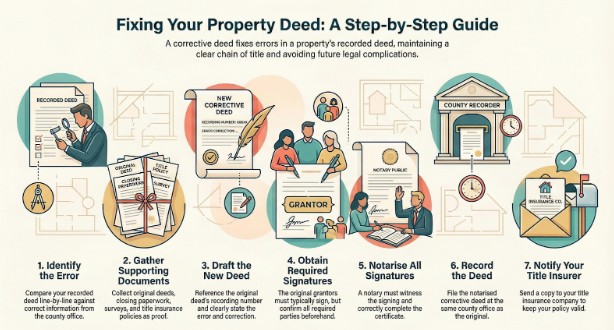
Drafting a corrective deed requires attention to detail. If you follow a careful process, you’ll keep your property records clean and your ownership clear—without creating new problems.
1. Identify the Error in Your Original Deed
Start by pulling your recorded deed from the county land records office. Go line by line and compare every detail—names, legal descriptions, recording info—against what should’ve been written.
2. Gather Supporting Documents
Get your hands on the original deed, closing paperwork, surveys, and any title insurance policies. These will help prove what the correct info should look like.
3. Draft the Corrective Deed
Reference the original deed by book and page number, or instrument number if that’s how your county does it. Spell out the error and the fix in plain language.
Sometimes, you’ll want to include a scrivener’s affidavit to explain that the mistake was a clerical error, not intentional.
4. Confirm Required Signers and Obtain Signatures
Corrective deeds are typically signed by the original grantor(s). Depending on the correction and title underwriting requirements, the grantee or additional parties may also need to sign and confirm required signers before scheduling notarization.
5. Have It Notarized
The signatures need a notary present. The notary must complete the certificate correctly, or you could face issues later.
6. Record at the County Office
Take the corrective deed to the same county where you filed the original. Recording it updates public records and keeps your chain of title clean.
7. Notify Your Title Insurance Company
Send copies to your title insurance provider. That way, future title searches reflect the correction, and your policy remains valid.
Legal Description Errors: The Ones That Commonly Break Closings
Wrong lot numbers and metes-and-bounds mistakes tend to derail real estate closings in Alabama more than you’d think. These errors in legal descriptions can create title defects that halt property transfers.
Common Alabama Deed Errors and the Safest Fix
Typographical mistakes in lot numbers happen all the time. If a deed lists “Lot 15” instead of “Lot 16,” that’s a serious mess for the chain of title and ownership.
Metes and bounds errors can get tricky. Maybe a survey shows “North 45 degrees East,” but the deed says “North 54 degrees East.” Even a tiny number swap can cause major legal headaches.
Misspelled owners’ names are another classic. If your deed shows “John Smyth,” but it should be “John Smith,” that simple typo can cloud the title.
Recording corrective deeds can correct these clerical errors without changing who owns the property. You’ll need to reference the original deed, spell out the specific error, and state the correct information.
If your legal description contains boundary errors, ask a licensed surveyor to conduct a new land survey. It might cost a bit, but it’s worth it to avoid bigger problems.
Deed mistakes disrupt your chain of title until you fix them properly through proper recording.
When a Corrective Deed Is Not Enough (Red Flags)
Some errors are just too big for a corrective deed. If your issue involves competing ownership claims, unclear boundaries, or title defects that really challenge who owns the land, you’ll need to go to court.
Practical Red Flags
When a bunch of people claim they own the same property, you’ve got a mess that probably needs a court to sort out. You can’t just use a corrective deed to fix ownership fights between folks who can’t agree on who really holds the title.
Boundary disputes with neighbors? Those usually call for a survey. And honestly, you’ll probably end up filing a quiet title action in circuit court.
If property lines are in question or the legal descriptions overlap and blur where your land actually ends, you’re facing more than a paperwork error.
Here’s when you should file a court petition:
- Someone else says they own all or part of your property
- The original deed handed over land that the seller didn’t even own
- You spot fraud or forgery in the title history
- The legal description is so off that it points to the wrong parcel entirely
Corrective deeds? They’re only suitable for small, obvious mistakes when everyone’s on the same page.
But when people disagree, you’ve got to go to court—think reformation actions or quiet title suits—to really settle who owns what.
Before you list, refinance, or sell, clear deed errors the right way. Schedule a consultation at (256) 993-5260 with Atkinson Law, P.C.
Contact Us Today For An Appointment
Frequently Asked Questions
What is a corrective deed in Alabama?
A corrective deed is a recorded document used to fix clerical errors in a previously recorded deed, so the public record reflects the original intent. It generally corrects mistakes without creating a new property interest or “re-selling” the property.
Can a corrective deed fix an incorrect legal description in Alabama?
Sometimes. Minor transcription issues that don’t change the parcel conveyed may be correctable after verification (prior deed, survey, title work). If the description points to a different parcel or boundary, you may need a new deed or court action.
Who has to sign a corrective deed in Alabama?
Typically, the original grantor(s) sign to confirm the correction. In practice, title/lender requirements may also call for grantee consent or additional signatures depending on the correction’s impact. Confirm signer requirements before scheduling notarization.
Does a corrective deed change ownership?
A corrective deed is intended to clarify the original conveyance—not change who owns the property. If the “correction” adds/removes an owner, changes the interest conveyed, or alters the deal, a new deed or court remedy is usually more appropriate.
What’s the difference between a corrective deed and a scrivener’s affidavit?
A corrective deed is a new recorded deed instrument that corrects an error. A scrivener’s affidavit is a sworn statement (often by the preparer) that explains a minor drafting error. Affidavits help with small errors but may not cure material defects.
Where do you record a corrective deed in Alabama?
Record it in the county land records where the property is located, typically the same county where the original deed was recorded. Consistent recording helps maintain a clean chain of title for future buyers, lenders, and title insurers.
What if the original grantor won’t sign—or is deceased?
If the needed signer is unavailable or uncooperative, a simple correction deed may not work. Depending on facts, solutions can include authority through an estate representative, a new conveyance, or a court action (reformation/quiet title).