

Get Legal Advice
(256) 993-5260
Alabama Home Closing Checklist:

Originally published: July 2026 | Reviewed by J. Wesley Atkinson
Alabama homebuyers need two forms of government-issued photo identification, certified closing funds, proof of homeowners insurance, and a reviewed Closing Disclosure to complete a real estate closing in North Alabama.
Sellers need a government-issued photo ID, mortgage payoff information, property keys, and bank account details for receiving proceeds.
Alabama requires a licensed attorney to oversee every residential closing — the closing attorney reviews title, prepares the deed, coordinates the settlement statement, and records the deed with the county probate office.
Key Takeaways
- Alabama buyers must bring certified funds — wire transfer or cashier’s check — to closing because Alabama closing attorneys do not accept personal checks for closing costs or down payments.
- Sellers should request a mortgage payoff statement from their lender at least 10 business days before closing to ensure the payoff amount reflects per diem interest through the closing date.
- The federal TILA-RESPA Integrated Disclosure rule requires lenders to deliver the Closing Disclosure to buyers at least three business days before closing.
- Spouses in Alabama must sign closing documents when selling a primary residence, regardless of whether both names appear on the title.
A missing document or a delayed wire can push your closing back by days or even weeks. J. Wesley Atkinson coordinates every detail of your North Alabama closing so nothing falls through on closing day. Get closing day confidence.
What Do Buyers Need to Bring to Closing in Alabama?
Alabama buyers who arrive at the closing table without the right documents face delays that can ripple through the entire transaction. A complete buyer checklist ensures the closing attorney can execute, fund, and record the transaction on the scheduled date.
- Two forms of government-issued photo ID. Alabama closing attorneys require at least one unexpired government-issued photo ID — a valid driver’s license, state-issued ID, or passport. Some lenders require a second form of identification, so buyers should confirm requirements with the closing attorney before the appointment.
- Certified closing funds. Buyers must bring a wire transfer confirmation or cashier’s check for the exact amount listed on the Closing Disclosure. Personal checks are not accepted at Alabama closings. Buyers who choose to wire funds should initiate the transfer at least 24 hours before the appointment, because wires submitted on the day of closing can take hours to confirm.
- Proof of homeowner’s insurance. The buyer’s lender requires a homeowner’s insurance binder showing coverage effective on or before the closing date. Buyers should provide the insurance agent’s name, company, email, and phone number to the closing attorney at least one week before closing.
- Reviewed Closing Disclosure. Federal law requires the lender to deliver the Closing Disclosure to the buyer at least three business days before closing. Buyers should compare every line item on the Closing Disclosure against the Loan Estimate they received at application — discrepancies in closing costs should be raised with the lender before closing day, not at the table.
- Purchase agreement and any addenda. Buyers should bring the signed purchase agreement and all amendments so the closing attorney can confirm the final terms match the settlement statement.
What Do Sellers Need to Bring to Closing in Alabama?
Alabama sellers have fewer documents to sign than buyers, but missing a single item — a payoff letter, a set of keys, or a spouse’s signature — can delay the entire transaction.
- Government-issued photo ID. The closing attorney verifies the seller’s identity before authorizing the deed transfer. An expired ID will not be accepted.
- Mortgage payoff statement. Sellers should request a payoff statement from every lender holding a mortgage on the property at least 10 business days before closing. The payoff statement must include per diem interest through the scheduled closing date, because interest accrues daily, and a stale payoff figure will be insufficient at the table.
- Property keys, garage remotes, and access codes. Buyers typically receive possession after the deed is recorded, and sellers must hand over all keys, gate remotes, mailbox keys, and alarm system codes at closing unless a separate post-closing possession agreement is in place.
- Bank account information for proceeds. Alabama closing attorneys disburse seller proceeds via wire transfer. Sellers should provide verified bank routing and account numbers to the closing attorney before closing day.
- Spousal signature. Alabama law requires both spouses to sign closing documents when selling a primary residence, even if only one spouse holds title. Sellers who are married must arrange for both spouses to attend — or provide an attorney-approved Power of Attorney if one spouse cannot be present.
If you’re ready to get started, call us now!
What Does the Closing Attorney Do on Closing Day in Alabama?
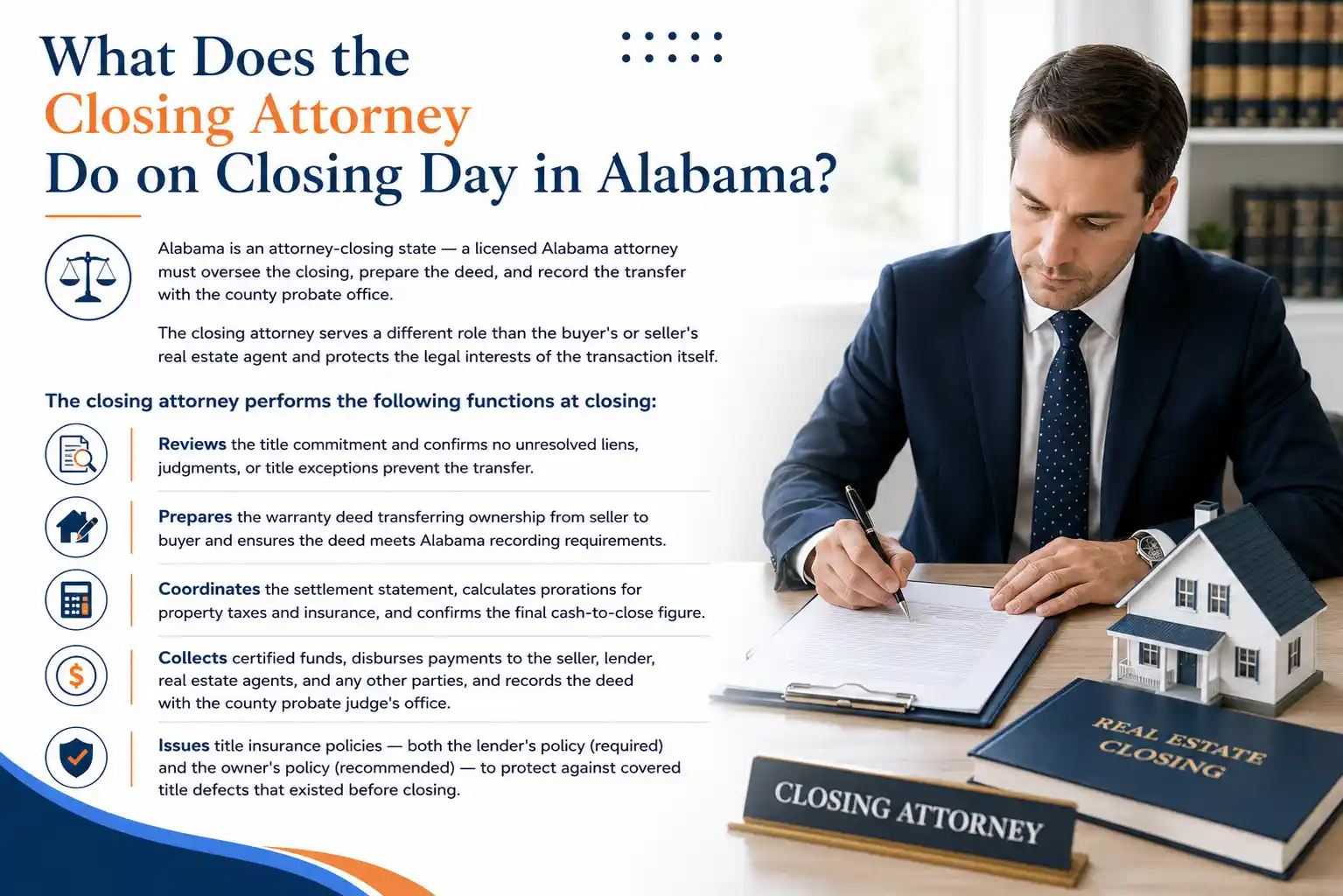
Alabama is an attorney-closing state — a licensed Alabama attorney must oversee the closing, prepare the deed, and record the transfer with the county probate office.
The closing attorney serves a different role from the buyer’s or seller’s real estate agent and protects the legal interests of the transaction itself.
The closing attorney performs the following functions at closing:
- Reviews the title commitment and confirms that no unresolved liens, judgments, or title exceptions prevent the transfer.
- Prepares the warranty deed transferring ownership from seller to buyer and ensures the deed meets Alabama recording requirements.
- Coordinates the settlement statement, calculates prorations for property taxes and insurance, and confirms the final cash-to-close figure.
- Collects certified funds, disburses payments to the seller, lender, real estate agents, and any other parties, and records the deed with the county probate judge’s office.
- Issues title insurance policies — both the lender’s policy (required) and the owner’s policy (recommended) — to protect against covered title defects that existed before closing.
How to Prepare Closing Funds and Avoid Wire Fraud
Wire fraud targeting real estate transactions is one of the fastest-growing financial crimes in the United States, and closings in Alabama are not immune.
Criminals hack or spoof email accounts belonging to real estate agents, title companies, or closing attorneys and send buyers fraudulent wire instructions that redirect closing funds to overseas accounts.
Alabama buyers should follow three steps to protect their closing funds:
- Verify wire instructions by phone using a phone number obtained independently — not from the email that provided the wire instructions. Call the closing attorney’s office directly to confirm the routing number, account number, and beneficiary name before sending any funds.
- Never rely on emailed wire instructions alone. Fraudulent emails often contain the correct property address, transaction amount, and professional formatting because the criminal has been monitoring the real transaction thread for weeks.
- Initiate wire transfers at least 24 hours before closing. Wires submitted on closing day can take hours to process, and the closing cannot proceed until the funds are confirmed in the escrow account. Late wires are one of the most common causes of same-day closing delays in Huntsville and Decatur transactions.
Fraudulent wire instructions can cost you your entire down payment — and recovery rates drop to near zero once funds leave the U.S. banking system.
Atkinson Law verifies every wire instruction through secure channels and coordinates confirmation of funds before you arrive at the closing table. Protect your closing funds.
Final Walk-Through Checklist Before Closing Day
The final walk-through is not a second home inspection — Alabama buyers use the walk-through to confirm the property’s condition has not changed since the inspection and that the seller has completed any negotiated repairs. Buyers should schedule the walk-through within 24 hours of closing.
During the walk-through, buyers should verify:
- All negotiated repairs have been completed, and receipts or contractor invoices are available.
- The seller has removed all personal property unless the purchase agreement specifies items that remain with the home.
- Every appliance, light switch, plumbing fixture, and HVAC system operates as expected.
- No new damage has occurred since the home inspection — water stains, broken windows, or missing fixtures that were not present during inspection should be documented and raised with the closing attorney before signing.
If you’re ready to get started, call us now!
Common Closing Delays in Alabama — and How to Avoid Them
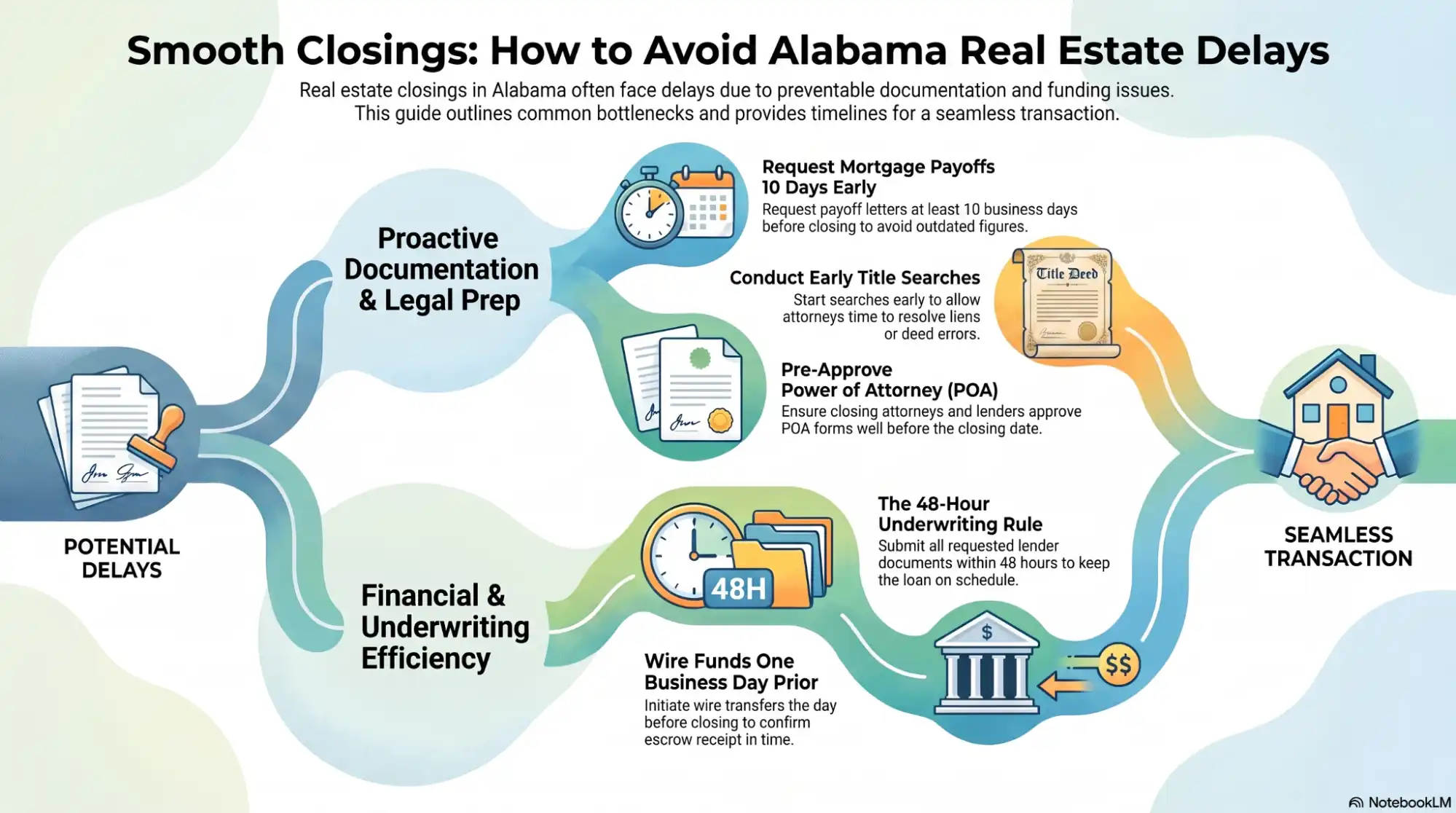
Closing delays in Alabama typically stem from preventable documentation and funding issues. Morgan County and Madison County closings run most smoothly when all parties submit documents early and confirm details with the closing attorney at least one week before the scheduled date.
- Late or missing mortgage payoff statements. Sellers who wait until the week of closing to request a payoff letter risk receiving an incomplete or outdated figure. Requesting the payoff at least 10 business days before closing eliminates this bottleneck.
- Title defects were discovered during the title search. Unreleased mortgage satisfactions, old judgment liens, and deed errors are common title issues that surface during a North Alabama title search. Running the title search early in the contract period gives the closing attorney time to resolve defects before the closing date.
- Lender underwriting delays. Buyers who submit incomplete documentation to their lender extend the underwriting timeline and push closing dates. Providing all requested documents — tax returns, bank statements, employment verification — within 48 hours of each lender’s request keeps the loan on schedule.
- Power of Attorney issues. A Power of Attorney used at an Alabama real estate closing must be reviewed and approved by both the closing attorney and the buyer’s lender before closing day. Generic online POA forms rarely contain the specific language that Alabama closing attorneys require — arriving at closing with an unapproved POA will force a postponement.
- Wire transfer timing. Wires initiated on closing day can take hours to clear. Buyers who wire funds the business day before closing give the escrow account time to confirm receipt.
Remote and Mail-Away Closings in North Alabama
Alabama buyers and sellers who cannot attend closing in person can arrange a mail-away or remote closing through the closing attorney’s office.
Alabama permits remote online notarization via videoconference, though many county probate offices still require wet-ink signatures on recordable documents like deeds and mortgages.
Parties planning a remote closing should notify the closing attorney as early as possible — ideally at contract execution — so the attorney can determine whether the county’s recording office accepts electronically notarized documents and arrange for overnight shipping of original documents if wet-ink signatures are required.
What Happens After the Closing Documents Are Signed?
The closing attorney records the warranty deed with the county probate office, which establishes the buyer as the new legal property owner.
Alabama charges a deed recording tax of $0.50 per $500 of property value — approximately 0.1% of the purchase price — which the closing attorney pays from the closing proceeds before disbursing remaining funds.
The closing attorney disburses seller proceeds, pays off the seller’s existing mortgage, and distributes commission payments to real estate agents.
Buyers should receive a recorded copy of the deed and their owner’s title insurance policy within several weeks after closing.
Sellers should verify within 45 days that their prior lender recorded a satisfaction of mortgage with the county probate office under Ala. Code § 35-10-92, because an unreleased mortgage lien can create title complications for the new owner.
Contact Us Today For An Appointment
Frequently Asked Questions
Can I use a personal check to pay closing costs in Alabama?
Alabama closing attorneys do not accept personal checks for closing costs or down payments. Buyers must bring a wire transfer confirmation or a cashier’s check issued by a bank for the exact amount listed on the Closing Disclosure. Certified funds protect all parties from insufficient-funds risks.
How early should I wire closing funds before my Alabama closing?
Alabama buyers should initiate wire transfers at least one full business day before the closing appointment. Wires submitted on the morning of closing can take several hours to confirm, and the closing cannot proceed until funds are verified in the escrow account.
Does my spouse need to attend closing if the house is only in my name?
Alabama law requires both spouses to sign the closing documents when selling a primary residence, regardless of whether either spouse’s name appears on the deed. A spouse who cannot attend must provide an attorney-approved Power of Attorney that meets the requirements of the closing attorney and the lender.
What happens if the title search reveals a problem before closing?
The closing attorney works to resolve title defects — unreleased mortgage liens, judgment liens, or deed errors — before the closing date. Minor issues can often be cleared within days through a corrective deed or a lien release. Larger defects may require a delay until the attorney obtains a court order or a satisfaction from the lienholder.
What is the final walk-through for in Alabama?
The final walk-through confirms the property’s condition has not changed since the home inspection and that the seller completed any negotiated repairs. Alabama buyers should schedule the walk-through within 24 hours of closing and document any new damage before signing at the closing table.
How long does a typical Alabama closing appointment take?
Alabama closing appointments typically last 60–90 minutes. Afternoon closings may run longer if the closing attorney’s office is processing multiple transactions on the same day. Buyers who review the Closing Disclosure in advance and arrive with all required documents help the appointment stay on schedule.
Do I need title insurance if I’m paying cash for a home in Alabama?
Alabama does not legally require title insurance for cash purchases, but an owner’s title insurance policy protects the buyer’s investment against covered title defects — including undisclosed liens, forged deeds, and recording errors — that a title search alone may not catch. The one-time premium covers the buyer for as long as the buyer or the buyer’s heirs own the property.
What documents will I receive after closing in Alabama?
Alabama buyers receive a recorded copy of the warranty deed from the county probate office, an owner’s title insurance policy (if purchased), and a copy of the final settlement statement. Sellers receive a copy of the settlement statement and should verify that their lender recorded a mortgage satisfaction within 30 days.
J. Wesley Atkinson handles title searches, deed preparation, fund coordination, and recording for North Alabama buyers and sellers — and every client works directly with their attorney from contract to keys. Secure a smooth closing.