

Get Legal Advice
(256) 993-5260

Originally published: July 2026 | Reviewed by J. Wesley Atkinson
A quiet title action is a lawsuit filed in an Alabama circuit court that resolves conflicting or unclear ownership claims to a property, establishing one clear, court-ordered owner of record.
Property owners need this remedy when heir property, adverse possession, unpaid tax liens, or gaps in the recorded chain of title make a property’s ownership legally uncertain.
Alabama recognizes two statutory paths — in personam and in rem — and a real estate attorney evaluates which one fits before filing.
Key Takeaways
- Alabama offers two quiet title paths: in personam (Ala. Code § 6-6-540) for known claimants and in rem (Ala. Code § 6-6-560) for unknown or unnamed parties.
- Heirs’ property, adverse possession claims, tax-sale purchases, and broken chains of title are the four most common triggers for filing.
- The circuit court where the property sits enters a quiet title judgment that, once final, bars future challenges to ownership.
- Alabama sets no fixed statute of limitations on quiet title actions, though underlying claims like adverse possession carry their own 10-year or 20-year clocks.
An unresolved title cloud can stall a sale or refinance for months. Atkinson Law reviews your title history and charts the clearest path forward.
What Is a Quiet Title Action in Alabama?
A quiet title lawsuit provides Alabama property owners with a single, enforceable determination of ownership when a competing or clouded claim calls the title into question.
Atkinson Law, P.C., a Decatur, Alabama, real estate and title law firm serving Huntsville, Athens, and Morgan, Lawrence, and Limestone Counties, files quiet title actions when a property’s chain of ownership contains a dispute, an unresolved lien, or an unknown claimant.
J. Wesley Atkinson, Attorney at Law, represents plaintiffs and defendants in both statutory forms of action available in Alabama.
If you’re ready to get started, call us now!
When Do You Need a Quiet Title Action in Alabama?
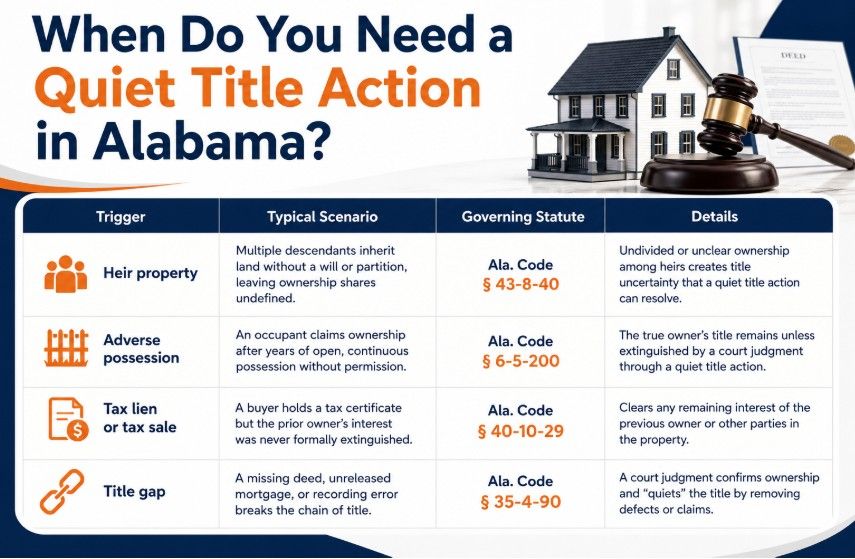
Property owners need a quiet title action whenever a recorded or unrecorded claim makes ownership legally uncertain — most often through heir property disputes, adverse possession, unpaid tax liens, or breaks in the recorded chain of title.
| Trigger | Typical Scenario | Governing Statute |
| Heir property | Multiple descendants inherit land without a will or partition, leaving ownership shares undefined | Ala. Code § 43-8-40 |
| Adverse possession | An occupant claims ownership after years of open, continuous possession without permission | Ala. Code § 6-5-200 |
| Tax lien or tax sale | A buyer holds a tax certificate, but the prior owner’s interest was never formally extinguished | Ala. Code § 40-10-29 |
| Title gap | A missing deed, unreleased mortgage, or recording error breaks the chain of title | Ala. Code § 35-4-90 |
How Does Heir Property Trigger a Quiet Title Action?
Heir property arises in Alabama when a landowner dies without a will, and the property passes to multiple heirs under intestate succession, splitting ownership into undivided fractional shares that block a clean sale.
Alabama’s intestate succession statute determines each heir’s fractional share, but it does not resolve disagreements over selling, financing, or occupying the land.
A quiet title action consolidates every heir’s claim into a single circuit court proceeding and produces one enforceable decree of ownership, so heirs can sell, finance, or divide the property without a competing claim resurfacing.
Families who also need long-term planning to prevent future heir property disputes should review estate planning options alongside any title action.
How Does Adverse Possession Lead to a Quiet Title Action?
Adverse possession lets an occupant claim ownership of Alabama property after 10 to 20 years of open, continuous, and hostile possession, and a quiet title action is the mechanism that formally transfers or defeats that claim in court.
Alabama’s adverse possession statute sets 10 years when the occupant holds recorded color of title and 20 years without it.
A property owner who discovers a long-term occupant should confirm whether the situation qualifies as statutory adverse possession before deciding between a quiet title action and an ejectment suit, so the correct legal remedy resolves the claim the first time.
Adverse possession claims only get stronger with time. Atkinson Law is investigating the occupant’s history now, before the 10-year clock runs out.
How Does a Tax Lien or Tax Sale Require a Quiet Title Action?
A tax lien purchase in Alabama does not, by itself, deliver marketable title — a quiet title action is often the only way to extinguish the prior owner’s redemption rights and convert a tax certificate into insurable title.
Alabama gives the original owner a three-year redemption window after a tax sale before a tax deed purchaser can pursue quiet title.
Buyers holding an older or defective lien should confirm whether it still clouds title before listing or refinancing the property, so the sale or loan can close without a title objection.
If you’re ready to get started, call us now!
What Is a Title Gap and How Does a Quiet Title Action Fix It?
A title gap is any missing link in the recorded chain of ownership — an unreleased mortgage, an unrecorded deed, or a probate record that was never filed — and a quiet title action closes that gap by asking a court to confirm current ownership despite the missing record.
Alabama follows a race-notice recording rule, meaning an earlier unrecorded interest can lose priority to a later purchaser who records first in good faith.
Sellers correcting a defective conveyance should compare a quitclaim deed against a warranty deed to confirm which instrument fits the gap before filing suit, so the corrected record supports a future sale or loan.
In Personam vs. In Rem: Which Quiet Title Action Applies in Alabama?
Alabama recognizes two statutory quiet title procedures — an in personam action against specific, known claimants and an in rem action against unknown or unnamed parties — and the correct choice depends on whether every potential claimant can be identified and served.
The in personam statute requires the plaintiff to already hold peaceable possession of the property, while the in rem statute allows a plaintiff without possession to sue the land itself.
A property owner facing an occupant who refuses to leave typically needs ejectment first, since quiet title alone cannot remove someone from possession.
| Requirement | In Personam | In Rem |
| Statutory basis | Ala. Code § 6-6-540 | Ala. Code § 6-6-560 |
| Defendants | Named, known claimants | Unknown or unnamed parties |
| Possession requirement | Plaintiff must hold peaceable possession | Plaintiff typically holds color of title, 10 years’ tax payment |
| Guardian ad litem | Not required | Required to represent unknown interests |
What Is the Step-by-Step Process for Filing a Quiet Title Action in Alabama?

Filing a quiet title action in Alabama involves a pre-filing title investigation, filing and serving notice on all claimants, and a court hearing that ends in a final decree, and each stage carries its own documentation requirements before the court will proceed to hearing.
Pre-Filing Title Investigation
An attorney orders a title search covering probate, tax, and recording office records to identify every person or entity with a potential claim to the property.
Filing and Notice
The plaintiff files a verified complaint in the circuit court where the property is located, then serves every named defendant or, in an in rem action, publishes notice to unknown claimants.
Hearing and Final Decree
The court holds a hearing, weighs the evidence of superior title, and — if the plaintiff prevails — enters a final decree that becomes the new record of ownership.
How Long Does a Quiet Title Action Take in Alabama?
The timeline for a quiet title action in Alabama depends on whether the case is contested; cases involving unknown heirs or unresolved tax liens take longer than uncontested filings.
Uncontested in rem actions with clean publication notice often resolve faster than in personam suits involving multiple defendants who dispute the plaintiff’s claim.
Buyers facing a closing deadline should coordinate early with a closing attorney to avoid a title action that delays the transaction.
What Does a Quiet Title Action Cost in Alabama?
Quiet title action costs in Alabama include attorney fees, filing fees, publication costs, and a title search, with contested cases and multiple unknown heirs incurring higher costs than an uncontested filing.
Title insurance underwriters frequently require a completed quiet title decree before issuing a policy on property with a known defect, making the litigation cost a necessary step toward an insurable title.
Comparing title insurance coverage types helps property owners understand what a cleared title actually protects.
Contact Us Today For An Appointment
Frequently Asked Questions
What is a quiet title action in Alabama?
A quiet title action is a circuit court lawsuit that resolves disputed or unclear ownership of Alabama real property. The court examines competing claims — from heirs, occupants, lienholders, or prior owners — and issues a final decree naming the legal owner, clearing the title of disputes.
Who can file a quiet title action in Alabama?
Any person claiming an ownership interest in Alabama real property can file a quiet title action, including heirs, tax-sale purchasers, and adjoining owners, to resolve boundary disputes. An in personam filer must hold peaceable possession before filing, while an in rem filer sues unknown claimants directly.
How long does a quiet title action take in Alabama?
The timeline for an Alabama quiet title action depends on whether the case is contested. Uncontested cases with straightforward publication notice resolve faster; contested cases involving unknown heirs, disputed tax sales, or multiple defendants who fight the claim take longer to reach a final decree.
Do I need a lawyer to file a quiet title action in Alabama?
Alabama law does not require an attorney to file a quiet title action, but the verified complaint, defendant identification, and notice-by-publication requirements carry strict procedural rules. A missed defendant or defective notice can void the decree, so most plaintiffs hire an attorney.
Can a quiet title action remove a tax lien in Alabama?
A quiet title action can extinguish a prior owner’s redemption rights after an Alabama tax sale, but it does not extinguish the tax debt itself if it remains unpaid. The action clears competing ownership claims so the tax-sale purchaser holds marketable, insurable title.
A title problem doesn’t resolve itself — it narrows your options every year it sits unfixed. Call Atkinson Law today for a clear path to ownership.