

Get Legal Advice
(256) 993-5260
Will vs Trust in Alabama:

Originally published: July 2026 | Reviewed by J. Wesley Atkinson
A will in Alabama is a written document that directs how your assets are transferred after death and must go through probate court before any beneficiary receives property.
A revocable living trust is a legal arrangement governed by the Alabama Uniform Trust Code (Title 19, Chapter 3B) that holds and distributes assets without probate, keeps your estate private, and allows a successor trustee to step in immediately if you become incapacitated.
Most North Alabama families benefit from understanding both tools before choosing one — or combining them. An estate planning attorney evaluates your assets, family structure, and goals to recommend the right approach.
Key Takeaways
- Alabama wills require two witnesses and must go through probate, which takes 6–12 months due to a mandatory 6-month creditor claims period.
- A revocable living trust avoids probate entirely, keeps asset details private, and provides built-in incapacity planning through a successor trustee.
- Alabama law presumes every trust is revocable unless the document expressly states otherwise (Ala. Code § 19-3B-602).
- A will remains the only legal tool in Alabama to appoint a testamentary guardian for minor children under Ala. Code § 26-2A-71.
Your family worked hard to build what you have — don’t leave the transfer to Alabama’s default intestacy rules. J. Wesley Atkinson drafts estate plans tailored to North Alabama families so your assets reach the right people without delays. Secure your family’s future.
What Is the Difference Between a Will and a Trust in Alabama?
A will takes effect only after the testator dies, and the Morgan County or Madison County Probate Court must validate the document before any distribution occurs. A revocable living trust takes effect the moment the settlor signs the trust agreement and funds it with assets — real estate, bank accounts, investment accounts — during the settlor’s lifetime.
Alabama imposes specific execution requirements for each tool. Ala. Code § 43-8-131 requires every will to be in writing, signed by the testator (or by another person at the testator’s direction and in the testator’s presence), and signed by at least two witnesses who observed either the signing or the testator’s acknowledgment.
A self-proving affidavit notarized under § 43-8-132 allows the will to be admitted to probate without requiring witness testimony.
A revocable living trust under the Alabama Uniform Trust Code (Ala. Code §§ 19-3B-101 et seq.) requires no witnesses and no notarization to be legally valid, though written documentation is strongly recommended.
The settlor typically names himself or herself as the initial trustee, retains full control of trust assets during life, and designates a successor trustee to manage distributions after death or incapacity.
| Feature | Alabama Will | Revocable Living Trust |
| When it takes effect | After death only | Immediately upon funding |
| Probate required | Yes — mandatory | No |
| Witness requirement | Two witnesses (§ 43-8-131) | None required |
| Public record | Yes — filed with Probate Court | No — remains private |
| Guardian appointment for minors | Yes (§ 26-2A-71) | No — requires a separate will |
| Incapacity planning | No — only governs post-death | Yes — successor trustee steps in |
If you’re ready to get started, call us now!
How Alabama Probate Affects Wills — and Why Trusts Avoid It
Alabama probate is a court-supervised process that validates a will, appoints a personal representative, inventories assets, satisfies creditor claims, and distributes the remaining estate to beneficiaries.
The mandatory creditor claim period in Alabama runs for six months from the date of first publication of notice to creditors, and no estate may close before that period expires.
Uncontested estates in Alabama typically take 6–12 months to close. Contested estates, or those involving real property in multiple counties, can take 18 months or longer. Alabama does not offer a fully independent administration procedure — every estate requires court oversight and a final settlement filing before the Probate Court will authorize distribution.
A revocable living trust bypasses probate entirely for any asset properly titled in the trust’s name. The successor trustee distributes trust assets in accordance with the trust agreement, without court involvement, public filings, or the six-month creditor waiting period.
Families who own real estate in North Alabama and want to avoid tying up a home or investment property in Morgan County Probate Court for months often use a trust to hold title.
Transferring real estate into a trust requires executing and recording a deed with the county probate judge’s office — Alabama does not impose a transfer tax on conveyances to revocable trusts.
Will vs Trust Comparison: Cost, Privacy, and Complexity
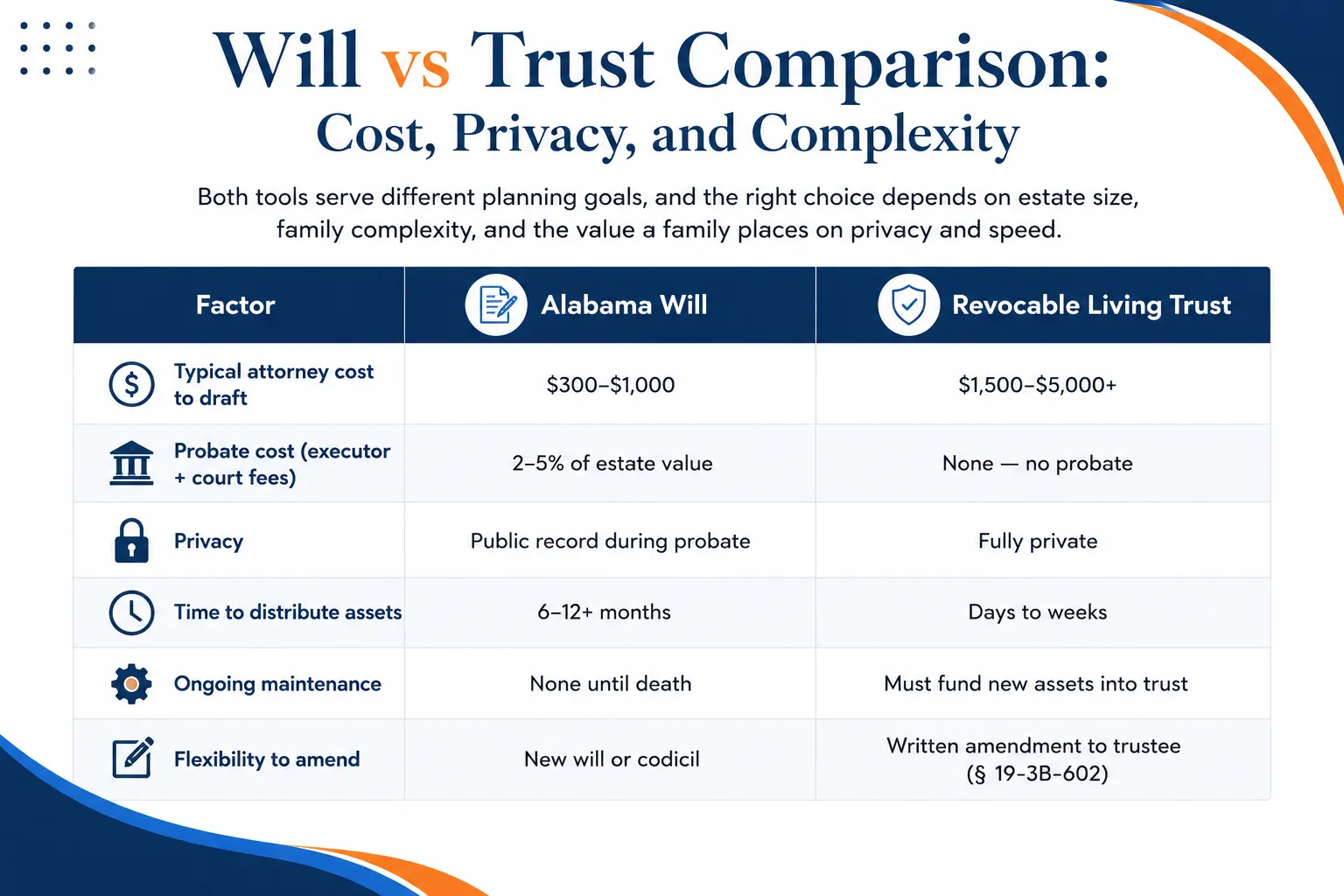
Both tools serve different planning goals, and the right choice depends on estate size, family complexity, and the value a family places on privacy and speed.
| Factor | Alabama Will | Revocable Living Trust |
| Typical attorney cost to draft | $300–$1,000 | $1,500–$5,000+ |
| Probate cost (executor + court fees) | 2–5% of estate value | None — no probate |
| Privacy | Public record during probate | Fully private |
| Time to distribute assets | 6–12+ months | Days to weeks |
| Ongoing maintenance | None until death | Must fund new assets into the trust |
| Flexibility to amend | New will or codicil | Written amendment to trustee (§ 19-3B-602) |
A will costs less to create, but probate adds attorney fees, executor compensation, court filing fees, and publication costs that accumulate after death. A trust costs more at creation but eliminates those post-death expenses.
For a North Alabama family with a $400,000 estate, probate costs at 3% total roughly $12,000 in combined fees — a figure that often exceeds the one-time cost of establishing a comprehensive estate plan built around a trust.
Thinking about how your business assets fit into your estate plan? Atkinson Law helps North Alabama entrepreneurs structure LLC operating agreements and estate documents together so ownership transfers cleanly. Protect your business legacy.
When an Alabama Will Is the Right Choice
A will is a practical starting point for individuals and families with straightforward estates. A North Alabama resident with a modest estate may find that a will paired with beneficiary designations achieves the same result as a trust at a lower initial cost.
A will-based plan works well when:
- The estate includes a primary residence, a bank account, a vehicle, and personal property — and beneficiary designations on retirement accounts and life insurance cover the largest assets.
- Total personal property (excluding real estate) falls below Alabama’s small estate threshold, which was approximately $47,000 for deaths in 2026 under Ala. Code § 43-2-692 — qualifying the estate for a simplified summary distribution process that reduces probate delays.
- The family includes minor children under 18 because a will is the only legal tool in Alabama to name a testamentary guardian — even families who also create a trust must execute a will to ensure the court follows their guardian preference rather than appointing one under Alabama’s default rules.
If you’re ready to get started, call us now!
When a Revocable Living Trust Makes Sense in Alabama
A revocable living trust becomes a stronger tool when privacy, speed, incapacity planning, or controlled distributions matter. Alabama families in the following situations often benefit from a trust-based plan:
- Multi-county or multi-state property ownership. A family that owns real property in more than one county — or more than one state — can use a trust to avoid opening separate probate proceedings in each jurisdiction. A North Alabama business owner who holds title to rental properties in Morgan and Madison Counties consolidates those assets under a single trust agreement.
- Incapacity protection. Without a trust, a family member must petition the probate court for a conservatorship to manage a loved one’s finances — a process that requires court approval, ongoing reporting, and legal fees. A properly funded revocable trust allows the named successor trustee to step in immediately and manage assets without court involvement.
- Blended family asset control. Blended families benefit from trust provisions that control how and when assets are distributed. A surviving spouse can receive income from trust assets during their lifetime, while the trust preserves the principal for children from a prior marriage — a level of control that a simple will cannot achieve.
Which Estate Planning Tool Fits Your Family?
| Scenario | Recommended Tool | Why |
| Single adult, small estate under $47,000 in personal property, no real estate | Will + beneficiary designations | Summary distribution available; trust overhead unnecessary |
| Married couple with minor children, primary home, modest savings | Will (guardian appointment) + trust for assets | Trust avoids probate on home; will names guardian |
| Blended family, children from prior marriages | Revocable trust + pour-over will | Trust controls distribution timing; protects both the spouse and the children |
| Business owner with LLC interests and investment property | Revocable trust + operating agreement | Trust holds LLC membership interests; avoids business disruption |
| Homeowner with property in multiple Alabama counties | Revocable trust | A single trust avoids probate in each county’s court |
Alabama has no state estate tax or inheritance tax, so the federal estate tax exemption — approximately $13.99 million per individual for deaths in 2026 — is the only estate tax threshold most North Alabama families need to consider.
For estates below that threshold, the choice between a will and a trust is driven by probate avoidance, privacy, and family complexity rather than tax savings.
Proper deed preparation is critical when funding a trust with Alabama real estate. A quitclaim deed or warranty deed must be executed and recorded with the county probate judge to transfer title into the trust’s name.
An improperly drafted or unrecorded deed leaves real property outside the trust — and subject to probate.
Contact Us Today For An Appointment
Frequently Asked Questions
Do I need both a will and a trust in Alabama?
Most Alabama estate plans pair a revocable trust with a pour-over will. The pour-over will catch any asset not yet in the trust and direct it there at death. A will remains the only way to appoint a guardian for minor children in Alabama.
Does a revocable living trust avoid probate in Alabama?
A revocable living trust avoids probate for every asset properly titled in the trust’s name. Assets that remain in the individual’s name — bank accounts without payable-on-death designations, untitled personal property, or real estate never deeded into the trust — still pass through Alabama probate court.
Is a handwritten will valid in Alabama?
Alabama does not recognize unwitnessed handwritten (holographic) wills. Every Alabama will must be signed by the testator and witnessed by at least two persons under Ala. Code § 43-8-131. A handwritten will executed in a state that recognizes holographic wills may still be admitted in Alabama under § 43-8-135.
How much does probate cost in Alabama?
Alabama probate costs typically range from 2–5% of the total estate value. Executor compensation, attorney fees, court filing fees, and publication costs are paid from the estate before beneficiaries receive distributions. The mandatory six-month creditor period extends the timeline regardless of estate simplicity.
Can I change a revocable trust after I create it?
Alabama Code § 19-3B-602 presumes every trust is revocable unless the document expressly states otherwise. A settlor can amend or revoke a revocable trust at any time by delivering a written amendment to the trustee or by following any method specified in the trust agreement.
What happens if I die without a will or trust in Alabama?
Alabama’s intestacy statute (Ala. Code § 43-8-41) controls distribution. A surviving spouse with children receives the first $50,000, plus one-half of the remaining estate; the children split the other half. A surviving spouse with parents but no children receives the first $100,000 plus one-half of the balance.
Does Alabama have a state estate tax?
Alabama imposes no state estate tax and no inheritance tax. The only estate tax that applies to Alabama residents is the federal estate tax, which affects individual estates exceeding approximately $13.99 million for deaths in 2026. Most North Alabama families fall well below this threshold.
How long does it take to set up a trust in Alabama?
An Alabama estate planning attorney typically drafts a revocable trust, pour-over will, durable power of attorney, and healthcare directive within two to four weeks. Funding the trust — retitling real estate and accounts into the trust’s name — adds two to six weeks.
J. Wesley Atkinson drafts wills, trusts, powers of attorney, and healthcare directives for North Alabama families from his Decatur office — and every client works directly with their attorney, not a paralegal. Claim lasting peace of mind.