

Get Legal Advice
(256) 993-5260
Alabama Boundary Disputes:
Originally published: October 2026 | Reviewed by J. Wesley Atkinson
Reviewed by J. Wesley Atkinson, founder of Atkinson Law, P.C., who cleared title claims for more than a decade as Assistant Counsel at Redstone Title Services before opening his Decatur practice.
An Alabama boundary dispute is a conflict between adjoining landowners over where the line separating their parcels actually runs.
Atkinson Law, P.C., a Decatur, Alabama, real estate attorney practice, reviews the deeds, title history, and surveys behind these conflicts across Madison, Morgan, Limestone, and Lawrence Counties.
A licensed boundary survey and a properly drafted, recorded agreed-line deed often resolve the conflict without a lawsuit.
Delay carries real risk because, under specific conditions, a neighbor’s long-term possession can shift the enforceable line.
Key Takeaways
- Ala. Code § 35-3-2 lets any owner of land, or of an interest in land, sue an adjoining owner in circuit court to establish the boundary line.
- Lee v. Brown, 482 So. 2d 293 (Ala. 1985), requires a neighbor claiming a disputed strip to prove open, notorious, hostile, continuous, and exclusive possession for 10 years.
- Ala. Code § 35-3-20 authorizes a circuit court to order its own survey of the disputed line while a case is pending.
- Ala. Code § 35-4-153 allows a court to reform a deed with an incorrect legal description due to fraud or mutual mistake, without prejudicing good-faith purchasers for value.
A neighbor’s fence or shed over the line can cloud title at the next sale. Atkinson Law, P.C. offers a boundary title review of the deeds and survey.
What Causes Boundary Disputes Between Alabama Neighbors?
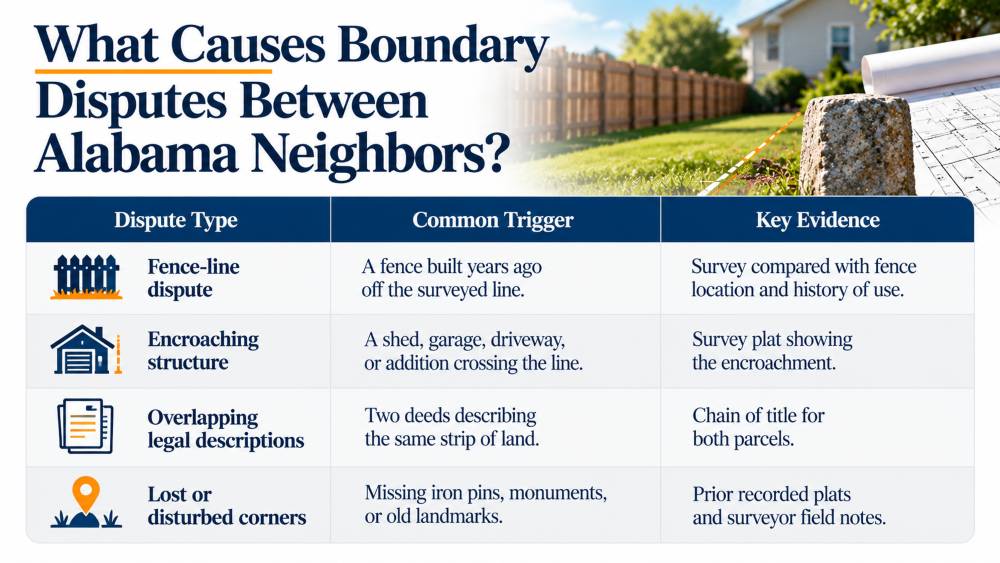
Alabama boundary disputes start when the legal description in a recorded deed no longer matches what sits on the ground. Four dispute patterns cover most conflicts between neighbors in Madison County and the surrounding North Alabama counties.
| Dispute Type | Common Trigger | Key Evidence |
| Fence-line dispute | A fence built years ago off the surveyed line | Survey compared with fence location and history of use |
| Encroaching structure | A shed, garage, driveway, or addition crossing the line | Survey plat showing the encroachment |
| Overlapping legal descriptions | Two deeds describing the same strip of land | Chain of title for both parcels |
| Lost or disturbed corners | Missing iron pins, monuments, or old landmarks | Prior recorded plats and surveyor field notes |
An overlapping description often traces back to a drafting error in an earlier deed, which a recorded corrective deed can fix when every affected owner acknowledges the mistake and signs.
How Does a Survey Prove Where the Property Line Is in Alabama?
A survey by an Alabama-licensed land surveyor provides strong evidence of the record boundary because it ties the deed’s legal description to physical points on the ground.
A survey does not, however, decide competing ownership claims, so the surveyed record line and the legally enforceable line can differ when a neighbor holds rights through adverse possession or another recognized doctrine.
A complete boundary survey typically shows:
- The deed line drawn from the recorded legal description
- Corner monuments found or set, such as iron pins
- Fences, driveways, and buildings that cross or touch the line
- Recorded easements that burden the disputed strip
Under Ala. Code § 35-3-20, a circuit court may also order its own survey during a pending case, and Ala. Code § 35-3-24 requires that surveyor to file a report and plat with the court.
Ownership rights to a strip can arise outside court, such as when a neighbor completes the adverse possession period, but a court judgment or a valid written agreement is how a contested line becomes conclusively established between the owners.
A survey ordered before a North Alabama closing can reveal an encroachment while the buyer and seller still have room to address it before the deed records.
Can a Neighbor Gain Land Through Adverse Possession in Alabama?
An Alabama neighbor can gain a disputed boundary strip through adverse possession, but only by proving every required element, and 10 years of occupation alone does not transfer title.
Lee v. Brown, 482 So. 2d 293 (Ala. 1985), requires possession that is open, notorious, hostile, continuous, and exclusive for the full 10 years.
Lee v. Brown also holds that the color-of-title, tax-listing, and inheritance requirements of Ala. Code § 6-5-200 do not apply to these boundary claims.
What Hostile Possession Means
Hostile possession means the neighbor occupies the strip as the owner, claiming the land as the neighbor’s own rather than with the record owner’s permission. Three fact patterns commonly defeat the hostility element:
- Permissive use: The record owner allowed the fence, garden, or driveway, so the use never ran against the owner’s title.
- Convenience fences: A fence placed off the line for terrain or livestock reasons, without any claim to the land behind it.
- Intent to hold only the true line: A neighbor who intended to claim only to the true line, wherever it falls, generally does not adversely possess the extra strip.
Who Carries the Burden of Proof
The neighbor claiming the strip carries the burden of proof, since Lee v. Brown holds that every presumption favors the record title holder. A stranger’s claim against vacant land instead falls under stricter Alabama squatter rules, and owners who spot an encroachment should act early to keep the possession facts clear.
If you’re ready to get started, call us now!
Should Alabama Neighbors Negotiate or Litigate a Boundary Dispute?
Negotiation often resolves Alabama boundary disputes faster and more cheaply than litigation because neighbors who accept the same survey can document the result without a court order.
Litigation becomes necessary when a neighbor rejects the survey, claims adverse possession, or refuses to remove an encroachment.
Settling the Line by Agreement
Neighbors who accept a common survey can document the agreed line through recorded deeds, often quitclaim deeds, though the right instrument depends on each owner’s title interests. An agreed-line deed typically includes three elements:
- A legal description tied to the accepted survey
- Signatures from every owner holding title to the affected strip
- Proper acknowledgment and recording with the probate judge in the county where the land sits, such as the Madison County Probate Office in Huntsville
A mortgage on either parcel adds a separate review step because the loan documents and the interest being transferred determine whether the lender needs to consent or whether a partial release is needed for that transaction.
Recording gives later buyers notice of the agreed line, but recording does not cure a missing signature or a flawed description.
A neighbor who only needs continued use of the strip, such as a shared driveway, can receive a recorded access easement while ownership stays with the record owner.
Taking the Line to Circuit Court
An owner whose neighbor refuses to settle can file suit under Ala. Code § 35-3-2, which directs the court to resolve every adverse claim needed to settle the line and to split costs as it considers just.
Atkinson Law, P.C. handles the transactional side of these disputes, including title review, deed preparation, and recording, rather than courtroom litigation.
An unresolved line can stall a sale or refinance at the worst moment. Atkinson Law, P.C. examines title and survey records to settle boundary questions before closing day.
Quiet Title vs. Ejectment: Which Alabama Action Fits a Boundary Dispute?
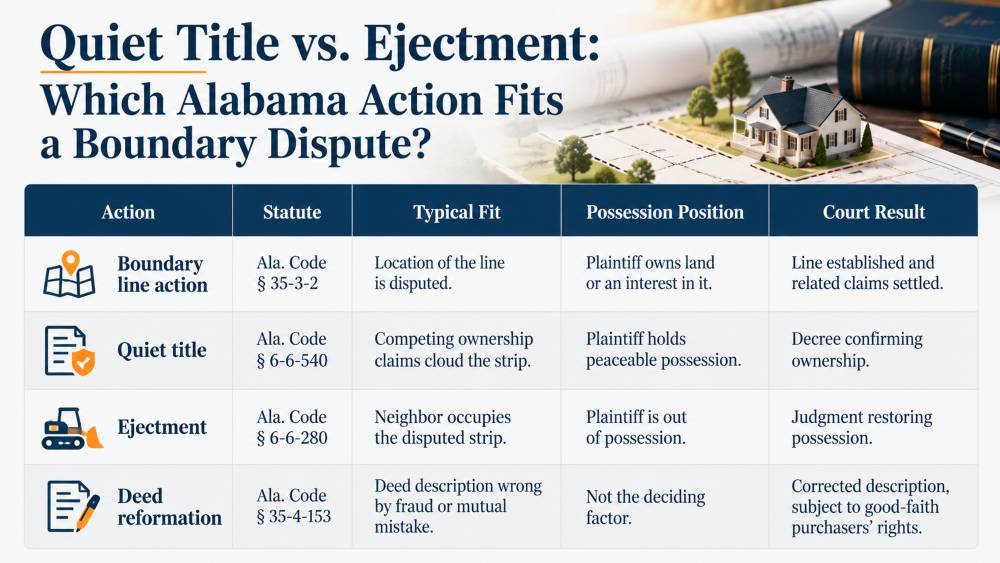
A boundary line action fits when the main question is where the line runs; quiet title fits an owner in peaceable possession who needs competing claims cleared, and ejectment fits an owner whose neighbor physically occupies the strip.
The table below is a general decision guide, not a test of litigation eligibility, because Alabama courts can combine claims in one case.
| Action | Statute | Typical Fit | Possession Position | Court Result |
| Boundary line action | Ala. Code § 35-3-2 | Location of the line is disputed | Plaintiff owns land or an interest in it | Line established and related claims settled |
| Quiet title | Ala. Code § 6-6-540 | Competing ownership claims cloud the strip | Plaintiff holds peaceable possession | Decree confirming ownership |
| Ejectment | Ala. Code § 6-6-280 | Neighbor occupies the disputed strip | Plaintiff is out of possession | Judgment restoring possession |
| Deed reformation | Ala. Code § 35-4-153 | Deed description wrong by fraud or mutual mistake | Not the deciding factor | Corrected description, subject to good-faith purchasers’ rights |
Peaceable possession under Ala. Code § 6-6-540 concerns possession, not title: the owner’s possession of the strip must remain undisturbed by the defendant’s possession, even though the defendant disputes title. The statute also requires that no suit is pending to test title, and a neighbor who physically holds the strip generally points the case toward ejectment.
Ejectment under Ala. Code § 6-6-280 is a lawsuit to recover physical control of land, while deed reformation asks a court to rewrite a mistaken description to match what the parties intended.
Litigation counsel confirms which quiet title action or combined claim fits the facts before filing.
What Happens When a Neighbor Rejects the Survey?
The right next step after a rejected survey depends on what caused the disagreement: a measurement discrepancy, a deed-description problem, or a possession claim.
Atkinson Law’s title review process pairs a boundary or easement problem with a survey and, where the parties agree, a negotiated title exception, so identifying the root cause early decides which records matter.
| Root Cause | Records to Compare | Typical Next Step |
| Measurement discrepancy | New survey, earlier recorded plat, surveyor field notes | Surveyors compare corner evidence; in some cases, a third survey helps resolve the difference |
| Deed-description problem | Both parcels’ deed chains and the plat each description came from | Corrective deed if all owners agree; reformation suit if not |
| Long-standing fence or possession claim | Dated photos, aerial imagery, tax records, witness accounts of use | Attorney evaluation of each possession element before any filing |
| Threat to remove a fence or structure | Survey, written correspondence, property photos | Attorney review of remedies before either owner acts, to reduce the risk of a damage claim |
A current deed, the earlier plat behind its description, and the new survey often disagree for different reasons, which is why a title review compares all three before choosing between a corrective deed, an agreed-line deed, and litigation. An owner holding an owner’s title policy should also pull that policy at this stage.
What Should an Alabama Property Owner Do First in a Boundary Dispute?
The first step in an Alabama boundary dispute is to order a current survey and gather the recorded documents for both parcels before confronting the neighbor.
Owners who request a title or deed review save time by bringing a complete file:
- The current deed and any prior deeds for the parcel
- Every survey or plat on record, including older ones
- The owner’s title insurance policy and title commitment from closing
- Dated photos of fences, structures, and corner markers
- Written correspondence with the neighbor about the line
Inherited land needs extra care, because a deed signed by only some co-owners of heir property generally conveys only those signers’ shares, leaving the agreed line open to challenge by the others.
Contact Us Today For An Appointment
Frequently Asked Questions
Does a fence mark the legal property line in Alabama?
A fence does not automatically mark the legal property line in Alabama because the recorded deed and survey evidence establish the record line. A fence affects ownership only when a neighbor’s possession up to the fence satisfies every element of adverse possession courts require.
Can a neighbor take part of a property through adverse possession in Alabama?
A neighbor can take part of an Alabama property only by proving open, notorious, hostile, continuous, and exclusive possession of a disputed strip for 10 years. Permissive use or a convenience fence usually defeats the claim, and the law presumes in favor of the record title holder.
Can a neighbor move a fence before an Alabama boundary dispute is resolved?
A neighbor who moves or removes a fence before an Alabama boundary dispute is resolved may face a trespass or property damage claim if the line falls elsewhere. Getting legal advice before either owner acts is a practical way to reduce that risk.
Who pays for a survey in an Alabama boundary dispute?
The owner who orders a survey pays for it before filing any lawsuit in an Alabama boundary dispute. Once a boundary case reaches circuit court, Ala. Code § 35-3-2 lets the judge split costs between neighbors as the court considers what is just under the circumstances.
Can Alabama neighbors settle a boundary dispute without going to court?
Alabama neighbors can settle a boundary dispute without court by recording deeds that describe an agreed survey line. Recording gives later buyers notice, but recording does not cure a missing owner’s signature, a flawed legal description, or an unmet lender requirement under an existing mortgage.
Does title insurance cover a boundary dispute in Alabama?
Title insurance may cover an Alabama boundary dispute, depending on the policy’s covered risks, exclusions, Schedule B exceptions, and any survey endorsement. Many owner’s policies exclude survey matters, so the owner should read the policy and promptly notify the title insurer in writing.
What is the difference between an easement and a boundary dispute in Alabama?
An easement dispute in Alabama concerns a right to use part of a neighbor’s land, while a boundary dispute concerns who owns the land itself. A recorded access easement can settle some boundary conflicts by granting continued use without moving the ownership line.
Can a boundary dispute delay an Alabama real estate closing?
A boundary dispute can delay an Alabama real estate closing when the title commitment lists the encroachment or survey problem as an exception. Buyers and sellers often address it before closing through a corrective deed, an agreed-line deed, or a negotiated title exception.
What is an ejectment action in Alabama?
An ejectment action in Alabama is a lawsuit under Ala. Code § 6-6-280 that an owner files to recover physical possession of land another person occupies. Owners use ejectment in boundary disputes when a neighbor holds the disputed strip and refuses to leave.
Bottom Line
Alabama boundary disputes turn on the recorded deed, a current survey, and whether a neighbor can prove every element of adverse possession for 10 years.
A survey shows the record line, while a court judgment or a valid written agreement conclusively establishes a contested one between the owners.
Ala. Code § 35-3-2 gives either neighbor a circuit court path, and many conflicts settle through properly signed and recorded agreed-line deeds.
A boundary question grows harder to fix each year it sits. Owners in Madison County and across North Alabama can call Atkinson Law, P.C. at (256) 993-5260 to request a title review with deeds, surveys, and the title policy ready.